
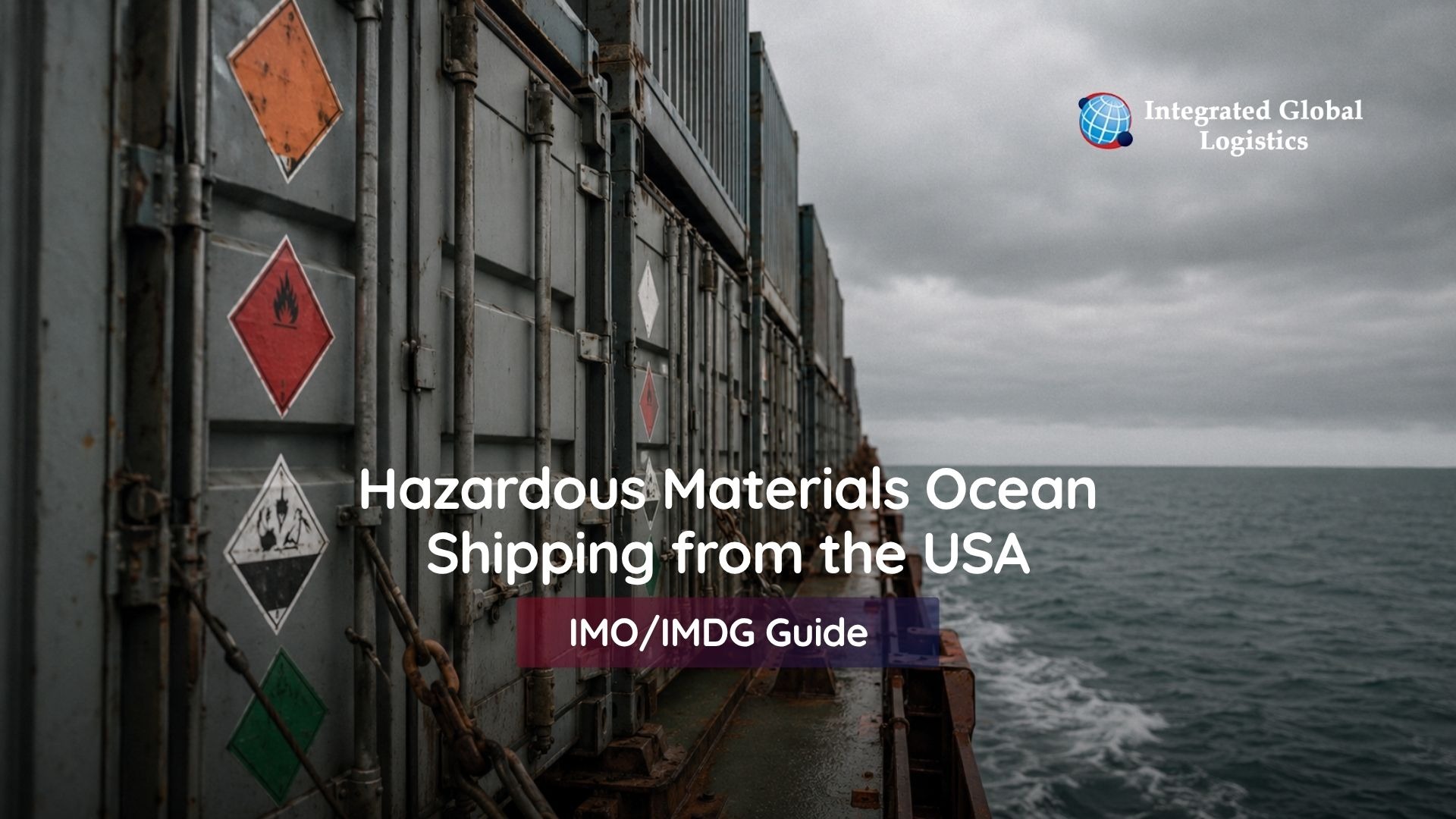
Hazardous materials ocean shipping is governed by the IMDG Code, the International Maritime Dangerous Goods Code developed by the IMO and mandatory under SOLAS. It sorts dangerous goods into nine hazard classes and sets the rules for classification, packing, marking, labeling, documentation, and segregation. Amendment 42-24 has been mandatory since 1 January 2026. Every shipment needs correct classification with a UN number, proper shipping name, and packing group, plus a Dangerous Goods Declaration, and in the USA it must also meet PHMSA requirements under 49 CFR.
Dangerous goods move by sea every day, from paints and aerosols to lithium batteries, industrial chemicals, and cleaning agents. What makes hazardous cargo different is not that it cannot be shipped, but that it must be shipped exactly right. A misdeclared or improperly packed dangerous goods container is a genuine safety risk to a vessel and its crew, and it is one of the fastest ways to have cargo rejected, fined, or held.
This guide explains how hazardous materials ocean shipping works from the USA: the framework that governs it, the nine hazard classes, the documentation that has to be right, and the compliance layers that apply. The aim is to help exporters understand what dangerous goods shipping actually requires, so that safe and compliant ocean freight is the outcome rather than a stalled container.
What Hazardous Materials Ocean Shipping Is
Hazardous materials, also called dangerous goods, are substances and articles that pose a risk to health, safety, property, or the environment during transport. When they move by sea, they are governed by the IMDG Code, the International Maritime Dangerous Goods Code, which the International Maritime Organization developed and which has been mandatory under the SOLAS convention since 2004.
The IMDG Code exists because poorly handled dangerous goods once caused frequent shipboard fires, explosions, and spills. It gives every party in the chain, from the shipper to the packer to the carrier, a single uniform rulebook covering classification, packaging, marking, labeling, documentation, stowage, and the segregation of substances that must not be stored together. Hazardous cargo moves on every major lane, from short hauls to long routings such as ocean freight to India, and the same framework applies wherever the container sails.
The Nine IMDG Hazard Classes
Every dangerous good is assigned to one of nine classes based on its primary hazard. Several classes are divided further into divisions. The table below is the backbone of dangerous goods classification.
| Class | Hazard | Common Examples |
|---|---|---|
| Class 1 | Explosives | Fireworks, ammunition, blasting agents |
| Class 2 | Gases | Aerosols, compressed and liquefied gases |
| Class 3 | Flammable liquids | Paints, solvents, alcohols |
| Class 4 | Flammable solids and related substances | Matches, certain metal powders |
| Class 5 | Oxidizers and organic peroxides | Pool chemicals, some fertilizers |
| Class 6 | Toxic and infectious substances | Pesticides, certain medical materials |
| Class 7 | Radioactive material | Certain instruments and medical isotopes |
| Class 8 | Corrosives | Acids, some batteries, cleaning agents |
| Class 9 | Miscellaneous dangerous goods | Lithium and sodium-ion batteries, marine pollutants |
Class 9 has grown in importance as lithium and sodium-ion batteries have spread through global trade, and it now carries some of the most closely watched rules on the water. Getting the class and division right is the first step of every compliant shipment.
IMDG Code 42-24: What Is Current in 2026
The IMDG Code is updated on a two-year cycle. Amendment 42-24, adopted by the IMO in 2024, has been mandatory since 1 January 2026, fully replacing the previous Amendment 41-22. Shipments must comply with the edition in force, and documentation such as a safety data sheet transport section that still references the old amendment can be treated as invalid.
The 42-24 changes reflect where the risks are moving. They include new UN numbers for sodium-ion batteries and for battery-powered vehicles, updated stowage and handling provisions for carbon, a new requirement for exemption certificates to accompany qualifying cargo, and dozens of revisions across the Dangerous Goods List, packing instructions, and special provisions. For shippers, the practical message is simple: procedures, training, and paperwork all need to match the current edition, because port state control does not accept an out-of-date reference.
Classification and DG Documentation
Correct classification is the foundation of a compliant dangerous goods shipment, and it is where most problems begin. Every substance is identified by a four-digit UN number and a proper shipping name, assigned a hazard class, and given a packing group that signals the degree of danger, from Packing Group I for high danger to Packing Group III for low.
The Dangerous Goods Declaration
The Dangerous Goods Declaration, or DGD, is the document in which the shipper formally declares the UN number, proper shipping name, class, packing group, and quantity, and certifies that the cargo is correctly classified, packed, marked, and labeled. It is a legal responsibility of the shipper, and an error on the declaration is one of the most common reasons a container is rejected at booking or stopped at the terminal. This is the single document where DG declaration handling by trained staff makes the clearest difference.
Supporting documents
A shipment also relies on a current safety data sheet, a container packing certificate confirming the unit was loaded correctly, and, where 42-24 requires it, an exemption certificate. Marine pollutants carry additional marking and declaration requirements under MARPOL Annex III. Consistency across every document is what keeps a dangerous goods booking moving.
Shipping Dangerous Goods from the USA?
Integrated Global Logistics is an FMC licensed NVOCC with DG-certified staff and in-house DG declaration handling for IMO/IMDG hazardous cargo, alongside FCL, reefer, and dry cargo. Tell us your UN number, class, and destination and our team will respond within one business day.
Talk to a Dangerous Goods SpecialistPacking, Labeling, and Segregation
Once cargo is classified, the physical requirements follow. Dangerous goods must be packed in UN-approved packaging tested to the standard for the packing group, marked with the UN number and proper shipping name, and labeled with the correct hazard class diamonds. Containers carrying dangerous goods are placarded so the hazard is visible to everyone handling the unit.
Segregation is the part that catches shippers new to dangerous goods. The IMDG Code specifies which substances must be kept apart, because some combinations react dangerously together. A flammable liquid and an oxidizer, for example, cannot be stowed as if they were ordinary cargo. Stowage rules also determine whether a container travels on deck or below, and a carrier will refuse a booking that does not respect these requirements. This is why dangerous goods bookings are planned around class and compatibility from the start rather than treated as standard freight.
The US Layer: PHMSA and Export Filing
For cargo leaving the USA, the IMDG Code is not the only rulebook. Domestic movement and preparation of hazardous materials are regulated by PHMSA, the Pipeline and Hazardous Materials Safety Administration, under Title 49 of the Code of Federal Regulations. Anyone who classifies, packs, or documents dangerous goods must complete function-specific training, which has to be refreshed periodically.
Export shipments also require electronic export information to be filed in the Automated Export System for qualifying cargo, and the US Coast Guard oversees dangerous goods at the ports. The practical effect is that a compliant hazardous export has to satisfy the domestic US regime, the export filing, and the international IMDG Code all at once, which is a large part of why experienced handling matters so much on this cargo.
Choosing a DG-Capable Partner
Dangerous goods shipping is one area where the choice of partner carries real weight, because the classification, the declaration, the packing standard, and the segregation all have to be correct before a carrier will load the container. A DG-capable forwarder classifies the cargo, prepares the Dangerous Goods Declaration, arranges compliant packing and labeling, books space with carriers that accept the class, and manages the stowage and segregation requirements end to end.
The traits to look for are DG-certified staff, in-house declaration handling, an FMC license, and carrier relationships that reliably accept hazardous bookings. Working with a licensed NVOCC also helps, and understanding what an NVOCC is clarifies how a partner can control the ocean carriage for regulated cargo. The best DG partners handle hazardous shipments alongside standard freight, so the same team that manages your reefer container shipping and dry cargo can also move your dangerous goods compliantly.
Integrated Global Logistics LLC is an FMC licensed NVOCC and international freight forwarder with more than 10 years of experience and 99.5% on-time performance. IGL handles IMO/IMDG hazardous and dangerous goods ocean freight with DG-certified staff and in-house DG declaration handling, alongside FCL, reefer, and dry cargo, with direct carrier contracts, real-time visibility, and coverage to 50+ countries worldwide.
Frequently Asked Questions
What is the IMDG Code?
The IMDG Code, or International Maritime Dangerous Goods Code, is the international rulebook for transporting dangerous goods by sea. It is developed by the International Maritime Organization and has been mandatory under the SOLAS convention since 2004. The Code sets uniform requirements for the classification, packaging, marking, labeling, documentation, stowage, and segregation of dangerous goods so that hazardous cargo moves safely between countries.
What are the nine hazard classes of dangerous goods?
The IMDG Code sorts dangerous goods into nine classes: Class 1 explosives, Class 2 gases, Class 3 flammable liquids, Class 4 flammable solids and related substances, Class 5 oxidizing substances and organic peroxides, Class 6 toxic and infectious substances, Class 7 radioactive material, Class 8 corrosives, and Class 9 miscellaneous dangerous goods, which includes lithium and sodium-ion batteries and marine pollutants. Several classes are further divided into divisions.
What is a Dangerous Goods Declaration?
A Dangerous Goods Declaration, or DGD, is the document in which the shipper declares the exact identity and classification of the hazardous cargo, including its UN number, proper shipping name, hazard class, and packing group. It certifies that the goods are correctly classified, packed, marked, and labeled for transport. The declaration is a legal responsibility of the shipper, and errors on it are a leading cause of cargo being rejected or held.
What is a UN number and packing group?
A UN number is a four-digit code that identifies a specific dangerous substance or article, paired with a proper shipping name. The packing group indicates the degree of danger within a class: Packing Group I is high danger, II is medium, and III is low. Together they determine the packaging standard, documentation, and handling a shipment requires, which is why correct classification is the foundation of a compliant dangerous goods move.
Which IMDG Code amendment is currently mandatory?
IMDG Code Amendment 42-24 has been mandatory since 1 January 2026, replacing Amendment 41-22. It was adopted by the IMO in 2024 and introduces changes including new UN numbers for sodium-ion batteries and battery-powered vehicles, updated stowage provisions for carbon, and a new exemption certificate requirement. Classification, packing, marking, labeling, and documentation must comply with the edition in force for the shipment.
What is a marine pollutant in ocean shipping?
A marine pollutant is a substance that is harmful to the marine environment and is regulated under MARPOL Annex III and the IMDG Code. Cargo identified as a marine pollutant must be marked with the marine pollutant symbol and declared, and it is subject to specific packing and stowage requirements. Many substances are both a marine pollutant and a member of one of the nine hazard classes, which affects how they must be handled.
Do I need special training to ship hazardous materials?
Yes. Anyone who classifies, packs, documents, or handles dangerous goods for transport must be trained for their function. In the USA, hazardous materials are also regulated by PHMSA under 49 CFR, which requires function-specific and recurrent training. Because the requirements are detailed and the liability is significant, many shippers rely on a forwarder with DG-certified staff to prepare the declaration and manage compliance rather than doing it in-house.
Do I need a freight forwarder to ship hazardous materials by sea?
A forwarder is not legally required, but dangerous goods shipping is one of the areas where experience matters most. A DG-capable forwarder or NVOCC classifies the cargo, prepares the Dangerous Goods Declaration, arranges compliant packing and labeling, books carrier space that accepts the class, and manages segregation and stowage requirements. Given the safety, legal, and financial stakes, an experienced DG partner is strongly advisable for most shippers.
IGL Freight Intelligence
IGL's Freight Intelligence content is produced by IGL's operations and ocean freight teams specializing in IMO/IMDG dangerous goods, FCL, reefer, and dry cargo ocean freight, and inland trucking across 50+ countries. (732) 250-9000 | info@integratedgl.com