
How to Ship FCL (Full Container Load) from the USA: Step-by-Step Exporter's Guide
A complete guide to the eight-step FCL shipping process for US exporters: from cargo assessment and container selection through carrier booking, documentation, vessel loading, and destination coordination.
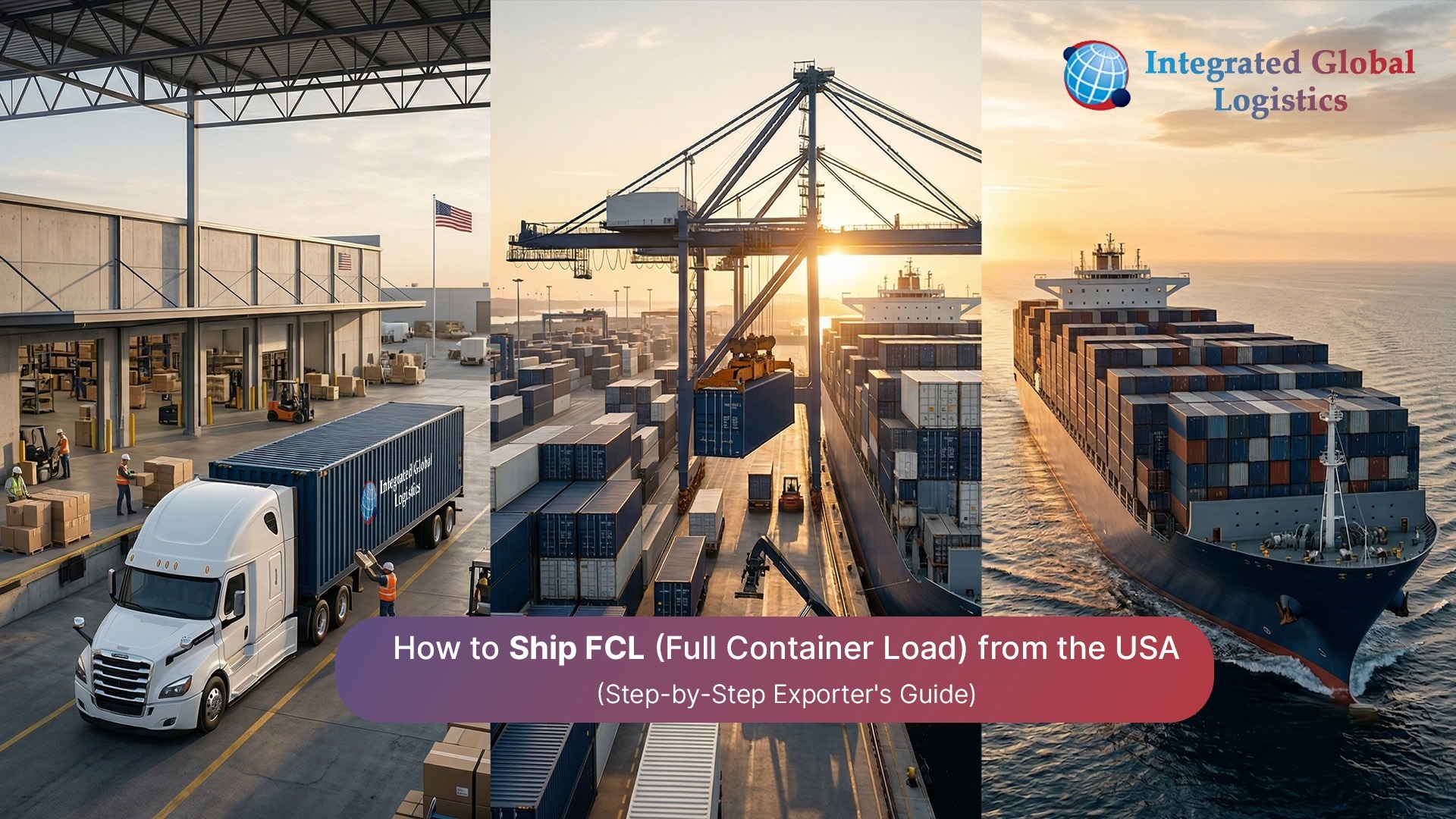
Shipping a Full Container Load (FCL) from the USA involves eight core steps: confirming your cargo is right for FCL and selecting the correct container type, engaging a Federal Maritime Commission licensed NVOCC to manage the booking and documentation, confirming the carrier rate and vessel schedule, receiving the empty container and loading your cargo, completing all required export documentation including AMS filing and any USDA or FDA certificates, returning the sealed container to port before the carrier cut-off, and monitoring the shipment through transit to coordinate destination clearance and delivery. Integrated Global Logistics manages every stage of this process as a licensed NVOCC, with active carrier contracts on US export lanes to 50+ countries and in-house documentation handling for food, agricultural, and general cargo.
FCL ocean freight is the most widely used mode for US commercial exports, but the process from first inquiry to delivered container involves more steps, more parties, and more documentation than most first-time shippers expect. Missing a single step, whether it is a late AMS filing, an incorrect bill of lading, or a container returned to port after the carrier cut-off, can delay an entire shipment by days or weeks and generate significant costs.
This guide walks through the complete FCL process for US exporters in the order it actually happens, covering what needs to be done at each stage, who is responsible for it, and where the most common errors occur. Whether you are moving your first container or looking to improve an established export operation, understanding the full process is the foundation of consistent, cost-effective FCL shipping.
What Is FCL Shipping?
FCL, or Full Container Load, is an ocean freight mode where a single shipper's cargo occupies and is dedicated to an entire shipping container for the complete journey from origin to destination. The container is loaded at the shipper's facility or a designated container freight station, sealed under the shipper's control, and transported directly to the destination port without intermediate unloading or shared handling.
In FCL shipping, the shipper has exclusive use of the container regardless of whether it is completely full. A shipper moving 20 CBM of cargo in a 40ft container (which has a usable volume of approximately 67 CBM) still books and pays for the full container. The commercial advantage is not the price per CBM but rather the speed, security, and accountability that come from a dedicated container moving directly from origin to destination.
FCL means your cargo is the only load on the container. It is loaded once at your facility and unloaded once at the destination. No shared handling, no intermediate offloading, no other shippers' freight involved. This is what makes FCL the preferred mode for time-sensitive, high-value, and temperature-sensitive commercial cargo.
When FCL Is the Right Choice for Your Cargo
FCL is not automatically the right choice for every international shipment. The mode decision should be based on your cargo volume, timeline, commodity type, and value. Here are the conditions under which FCL is clearly the correct choice.
- Volume above 15 CBM. For most commercial shipments above 15 CBM, FCL offers better per-unit economics than alternatives, in addition to the operational advantages of dedicated container handling.
- Time-sensitive cargo. FCL moves directly from origin to destination without consolidation or deconsolidation steps. If your delivery has a fixed window, FCL provides the scheduling certainty that shared modes cannot guarantee.
- High-value freight. Dedicated container handling eliminates the multiple touchpoints that create damage exposure. For expensive goods, the lower damage risk of FCL reduces insurance exposure and cargo claims.
- Temperature-sensitive cargo. Reefer FCL maintains a single dedicated temperature environment from loading through delivery. This is the only viable mode for frozen or chilled food, pharmaceuticals, and perishables requiring uninterrupted cold chain integrity during ocean transit.
- Hazardous cargo. Many IMDG-classified hazardous materials require dedicated container stowage, making FCL the operationally appropriate choice regardless of volume.
- Regular export programs. If you ship the same trade lane on a recurring basis, FCL allows you to build a contracted rate relationship with a licensed NVOCC, securing consistent pricing and priority space allocation that ad-hoc shipping cannot deliver.
The practical question for US exporters is whether your cargo volume, timeline, and commodity type make a dedicated container the operationally correct choice. For commercial shippers moving product regularly to international buyers, FCL is typically the right answer. IGL's ocean freight team will assess your specific cargo profile and confirm the most appropriate container mode before any booking is made.
FCL Container Types and Sizes
The container selection is the first operational decision in an FCL shipment, and it has direct consequences for both cost and cargo integrity. The wrong container type can mean loading delays, booking rejections, or compromised cargo conditions during transit.
| Container Type | Internal Volume | Max Payload | Primary Use Cases |
|---|---|---|---|
| 20ft Standard Dry | ~33 CBM | ~28,000 kg | Dense or heavy cargo where weight limits are the constraint; machinery, chemicals, raw materials |
| 40ft Standard Dry | ~67 CBM | ~26,500 kg | General commercial cargo; consumer goods, industrial products, packaged food |
| 40ft High-Cube Dry | ~76 CBM | ~26,500 kg | Most common US export unit; agricultural products, retail goods, packaged food, anything benefiting from extra height clearance |
| 20ft Reefer | ~28 CBM | ~22,000 kg | Smaller refrigerated volumes; pharmaceuticals, specialty food products requiring a dedicated temperature environment |
| 40ft High-Cube Reefer | ~67 CBM | ~22,000 kg | Standard unit for US food exports; frozen meat, poultry, seafood, dairy, fresh produce at commercial scale |
| Flat Rack (20ft/40ft) | Open deck | Varies by unit | Oversized machinery, vehicles, construction equipment that cannot be loaded through standard container doors |
| Open Top (20ft/40ft) | Standard body, no roof | ~26,000 kg | Tall cargo loaded by crane; steel coils, large industrial equipment, structural components |
The 40ft high-cube dry van is the most widely available and most commonly booked container type for US commercial exports. On most trade lanes, it provides the best combination of volume capacity, carrier availability, and per-unit freight economics. Your NVOCC should confirm container availability on your specific trade lane before finalizing the booking, particularly for reefer equipment, which is less abundant than dry containers across most routes.
The 8-Step FCL Shipping Process from the USA
The following steps cover the complete lifecycle of an FCL shipment from the first commercial decision through to delivered cargo at the destination. Each step feeds into the next. Delays or errors at any stage cascade forward and affect the whole shipment.
Assess Your Cargo and Confirm FCL Is the Right Mode
Before any booking is made, confirm the following: your cargo volume in CBM and weight, the commodity HS code and any hazardous classification, whether temperature control is required during transit, your required delivery date at destination, and the Incoterms under which the sale is made (FOB, CIF, DAP, etc.). These details determine the container type, the origin port that best serves your shipment, the carrier services available on your lane, and the documentation requirements that will apply.
This assessment stage is where your NVOCC earns its value. A licensed provider will review your cargo profile, identify any compliance requirements specific to your commodity and destination, and recommend the most appropriate routing before a container is ever dispatched.
Engage a Licensed NVOCC and Confirm Your Rate
Once your cargo profile is clear, engage a Federal Maritime Commission licensed NVOCC to manage the shipment. The NVOCC will issue your House Bill of Lading, negotiate container space with the ocean carrier, file the AMS with US Customs and Border Protection, and coordinate all carrier-side documentation.
At this stage, confirm the full itemized rate: base ocean freight, Bunker Adjustment Factor (BAF), Origin Terminal Handling Charge (OTHC), Destination Terminal Handling Charge (DTHC), AMS fee, and bill of lading fee. The difference between a headline rate and a total landed rate is often found in how these surcharges are presented. Understanding the full cost structure before booking prevents invoice surprises after the vessel departs. IGL's guide to what drives FCL ocean freight rates covers each of these components in detail.
Confirm the Vessel Schedule and Booking Details
Once the rate is agreed, the NVOCC places a container booking with the ocean carrier on your chosen vessel rotation. This generates a booking confirmation that specifies the vessel name and voyage number, port of loading, estimated time of departure (ETD), port of discharge, estimated time of arrival (ETA), and the container equipment order number used to release the empty container to your facility.
Review all booking details carefully at this stage. Errors in the port of loading, container type, or vessel schedule are far easier to correct before the container equipment is dispatched than after. Your NVOCC should provide the booking confirmation in writing before any cargo preparation begins.
Receive the Container and Load Your Cargo
The ocean carrier dispatches an empty container to your facility based on the equipment order from the NVOCC. Before loading begins, inspect the container for structural integrity, cleanliness, and the absence of contamination or odors. Document any pre-existing damage with photographs before the first item of cargo is loaded.
Load cargo according to weight distribution guidelines (heavier items on the floor, cargo secured to prevent shifting during the ocean voyage), leaving adequate clearance for container door closure. Record the container seal number after sealing and provide it to your NVOCC. You are also responsible for submitting the Verified Gross Mass (VGM) to the carrier before the vessel's VGM cut-off deadline. VGM is mandatory under SOLAS regulations and failure to submit it on time can result in the container being rolled to a later vessel.
For reefer shipments, confirm with the carrier that the container has been pre-cooled to the required set point before loading begins. Never load warm product into a reefer container and expect it to chill during transit.
Complete All Export Documentation
Documentation for an FCL export from the USA must be complete and accurate before the vessel's document cut-off deadline, which typically falls one to three days before the estimated vessel departure date. Late or incorrect documentation is one of the most common causes of rolled containers and port holds.
The shipper is responsible for providing accurate cargo details to the NVOCC: the commercial invoice, packing list, Shipper's Letter of Instruction (SLI), and any commodity-specific export certificates. The NVOCC uses this information to prepare and issue the House Bill of Lading, file the AMS manifest with US Customs and Border Protection, and coordinate Electronic Export Information (EEI) submission through the Automated Export System (AES).
For US food and agricultural exports, additional documentation is required. IGL's team manages USDA export health certificate coordination, FDA Prior Notice filing support, and AMS submission as standard components of its ocean freight service. Shippers do not need to engage separate documentation agents for these filings on standard US food export lanes.
AMS Filing and Pre-Departure Compliance
The Automated Manifest System (AMS) filing is the mandatory submission of cargo manifest information to US Customs and Border Protection (CBP) for all ocean freight departing the United States. It must be submitted by the NVOCC before the vessel departs. CBP uses AMS data to conduct pre-departure risk assessment on all US-bound and US-origin ocean cargo.
As a licensed NVOCC, Integrated Global Logistics files AMS directly in-house as part of every FCL ocean freight booking. This eliminates the third-party filing delay that occurs when AMS is outsourced to a separate customs broker, and ensures the filing is completed well ahead of the vessel's departure deadline rather than at the last minute.
For imports into the USA, ISF (Importer Security Filing, also known as 10+2) is the equivalent pre-arrival filing requirement, submitted by the NVOCC on behalf of the importer before the vessel departs the foreign origin port. Both AMS and ISF filing are covered in IGL's standard FCL service for US export and import shipments respectively.
Return the Container to Port and Confirm Vessel Loading
The loaded, sealed container must be transported to the origin port terminal and gated in before the carrier's container cut-off deadline. The cut-off is typically 24 to 48 hours before the vessel's estimated time of departure, though this varies by port, terminal, and carrier. Missing the cut-off means the container is rolled to the next available vessel on that trade lane, which may be several days to a week later.
If you are responsible for arranging inland transport from your facility to the port, this is where integrating domestic trucking with the ocean freight booking becomes operationally important. IGL coordinates both the inland FTL transport from the origin facility to the US export port and the ocean freight booking, which eliminates the scheduling gap that occurs when these two legs are managed by separate providers.
Once the vessel has departed, the NVOCC issues the on-board Bill of Lading confirming that the container is loaded and the ocean carrier has accepted responsibility for the cargo. This document is required to release the cargo at the destination port.
Monitor Transit and Coordinate Destination Clearance
Once the vessel is underway, the active work shifts to monitoring the shipment and preparing the destination for arrival. IGL provides real-time vessel tracking through its Customer Digital Portal, with milestone notifications at each port call during the voyage. Shippers can monitor ETA updates and container status without needing to contact the operations team for routine updates.
Destination clearance preparation should begin during transit, not after arrival. This includes preparing or obtaining the original Bill of Lading for presentation at destination (or arranging a Sea Waybill release if applicable), coordinating with the consignee's customs broker, confirming destination port handling and delivery arrangements, and preparing any country-specific import documentation required by the destination customs authority.
For reefer shipments, destination coordination also includes pre-arranging cold store reception before the vessel arrives, to avoid the cargo sitting without power at the destination terminal during clearance. IGL's verified destination agent network handles this coordination as standard for refrigerated cargo shipments on all active trade lanes.
Ready to Book Your FCL Shipment?
IGL is an FMC-licensed NVOCC handling FCL ocean freight from all major US export ports. Tell us about your cargo and we will respond within one business day.
Get an FCL QuoteFCL Export Documentation: A Complete Reference
Documentation errors are responsible for a significant share of FCL shipment delays, port holds, and carrier penalties. The following reference covers every document required for a standard US FCL export and identifies which party is responsible for preparing it.
Commercial Invoice
Full commodity description, HS code, country of origin, unit price, total value, and complete buyer and seller details. Must be accurate and consistent with all other shipping documents.
Packing List
Detailed breakdown of carton count, gross and net weights, dimensions per carton or pallet, and total container load summary. Must reconcile with the commercial invoice.
Shipper's Letter of Instruction (SLI)
Directs the NVOCC on how to prepare the bill of lading, who the consignee and notify party are, the terms of delivery, and any special handling instructions. The SLI is the primary instruction document from shipper to NVOCC.
Verified Gross Mass (VGM)
Mandatory under SOLAS. The total verified weight of the loaded container including cargo, packing, and container tare. Must be submitted to the carrier before the VGM deadline. The shipper is legally responsible for VGM accuracy.
House Bill of Lading (HBL)
Issued by the NVOCC to the shipper as a receipt for cargo, a contract of carriage, and a document of title. The HBL is the primary document used to release cargo at the destination. A licensed NVOCC like IGL issues its own HBL and assumes direct carrier liability.
AMS (Automated Manifest System)
Mandatory CBP filing before vessel departure. Filed by the NVOCC in-house at IGL as part of every FCL booking. Failure to file or late filing triggers CBP holds that can delay vessel departure for the entire container.
Electronic Export Information (EEI)
Filed through AES (Automated Export System) for most US exports above the AES filing value threshold per Schedule B number. Required before the cargo reaches the port of export. NVOCC or licensed customs broker typically manages this filing on behalf of the shipper.
USDA Export Health Certificate
Required for US meat, poultry, and dairy exports. Issued by USDA FSIS or AMS for the specific commodity. IGL holds USMEF and USAPEEC certifications and coordinates health certificate requirements as part of its refrigerated cargo service for food export lanes.
AMS and ISF Filing: What US FCL Shippers Need to Know
AMS and ISF are the two mandatory pre-departure and pre-arrival electronic filing requirements that apply to FCL ocean freight involving the United States. Understanding which applies to your shipment and when it must be filed is essential to avoiding CBP holds and vessel departure penalties.
AMS (Automated Manifest System) for US Exports
AMS filing is required for all ocean cargo departing the United States. The NVOCC or carrier files the cargo manifest electronically with US Customs and Border Protection before the vessel departs. CBP uses the AMS data to assess risk, flag shipments for inspection, and build its record of US export activity by commodity and trade lane. AMS filing is the responsibility of the NVOCC, not the shipper. As a licensed NVOCC, Integrated Global Logistics files AMS in-house for every FCL ocean freight shipment, ensuring timely and accurate submission without third-party filing delays.
ISF (Importer Security Filing) for US Imports
ISF, also known as 10+2 filing, is the pre-arrival security filing required for all cargo imported into the United States by ocean freight. It must be submitted to CBP at least 24 hours before the vessel departs the foreign origin port. ISF is the responsibility of the US importer, typically filed by the NVOCC or customs broker managing the import on the importer's behalf. Late or inaccurate ISF filing results in CBP penalties that are levied against the importer. IGL manages ISF filing in-house for all US import FCL shipments as part of its standard NVOCC ocean freight service.
AMS must be filed before vessel departure. ISF must be filed at least 24 hours before the vessel departs the foreign port. Both filings are mandatory, not optional, and both generate CBP penalties when late or inaccurate. In-house filing by a licensed NVOCC is the most reliable way to ensure both requirements are met correctly and on time on every shipment.
US Export Ports for FCL Ocean Freight
The origin port you use for your FCL shipment affects both the freight rate and the total transit time to your destination. For US exporters, the optimal port choice balances inland transport cost from the origin facility against the ocean freight rate and transit time available from that gateway.
- Los Angeles and Long Beach (San Pedro Bay). The highest-volume US container port complex and the primary gateway for Trans-Pacific trade to Asia. Widest carrier choice and most frequent departures on Asian trade lanes. Best option for US West Coast shippers exporting to East and Southeast Asia.
- Port of New York and New Jersey. The dominant East Coast gateway with strong transatlantic service to Europe and direct services to the Middle East and India. Most competitive for shippers located in the Northeast and Mid-Atlantic regions.
- Port of Miami. Competitive for Caribbean, South American, and European lanes. Strong reefer handling infrastructure, making it a frequently used gateway for US food exports to the Caribbean and Latin American markets.
- Port of Houston (Bayport and Barbours Cut). The primary Gulf Coast gateway, competitive for Latin American lanes and certain Middle East services. Well-positioned for US food exporters in the central US, particularly for meat, grain, and processed food exports.
- Port of Savannah and Charleston. Both have grown significantly in capacity and carrier service frequency. Competitive rates on transatlantic and Asia services from the Southeast US, with good reefer handling for agricultural exports from the region.
- Port of Baltimore, Norfolk, and Philadelphia. Serve specific cargo types and regional shippers on the East Coast, with particular strengths in vehicles, heavy lift, and breakbulk alongside containerized FCL services.
Your NVOCC should assess port optionality as part of the rate quotation, not just present the rate from the nearest gateway. The combination of inland transport cost from your facility to the port and the ocean freight rate from that port to your destination determines the total landed cost. In many cases, routing through a port that is not geographically closest to your facility produces a better total cost outcome.
Common FCL Shipping Mistakes and How to Avoid Them
The following are the most common errors that cause FCL shipment delays, cargo holds, and unexpected costs for US exporters. Each one is avoidable with proper preparation and a qualified NVOCC managing the process.
- Missing the container cut-off deadline. The loaded container must arrive at the terminal before the carrier's cut-off, typically 24 to 48 hours before vessel departure. Missing it results in a rolled container and a delayed shipment. Always confirm the exact cut-off deadline with your NVOCC at booking.
- Incorrect or incomplete commercial invoice details. HS code errors, value discrepancies, or missing buyer details cause CBP scrutiny, carrier documentation holds, and destination customs delays. The commercial invoice and packing list must be accurate and consistent before the SLI is submitted to the NVOCC.
- Late VGM submission. VGM is mandatory under SOLAS and must be submitted before the carrier's VGM deadline. A missing or late VGM means the container cannot be loaded onto the vessel, resulting in a rolled shipment regardless of whether all other documentation is correct.
- Loading warm product into a reefer container. A reefer container maintains temperature but cannot reduce it. Cargo must be pre-chilled or pre-frozen to the required set point before loading. Warm cargo in a reefer container results in temperature excursions and cargo loss that is not covered by standard marine insurance.
- Booking through an unlicensed intermediary. Any party issuing bills of lading and accepting cargo responsibility without a valid FMC NVOCC license is operating illegally in US trades. Shippers working with unlicensed intermediaries have no surety bond protection, no regulated accountability, and no recourse through the FMC in the event of a dispute. Always verify FMC license status at fmc.gov before engaging an NVOCC.
- Comparing rates without comparing surcharges. A lower base ocean freight rate often carries higher terminal handling or documentation fees. The only valid rate comparison is a fully itemized all-in quote that includes every applicable surcharge for your specific lane and cargo type.
IGL is a Federal Maritime Commission licensed NVOCC and full-service international freight forwarder based in Riviera Beach, Florida. IGL operates on US export lanes to the Middle East, Southeast Asia, East Asia, Europe, and Latin America with active carrier service contracts and in-house AMS, ISF, and export documentation handling. IGL holds USMEF certification for US meat export logistics and USAPEEC certification for US poultry and egg export logistics. For FCL ocean freight inquiries: (732) 250-9000 or info@integratedgl.com.
Frequently Asked Questions: How to Ship FCL from the USA
What is FCL (Full Container Load) shipping?
FCL (Full Container Load) shipping is an ocean freight mode where a single shipper's cargo occupies and is dedicated to an entire container for the complete journey from origin port to destination port. The container is loaded at the shipper's facility, sealed, and transported directly without intermediate unloading or shared handling with other shippers' cargo. FCL provides faster transit times, lower damage risk, and clear carrier accountability because the cargo is handled only twice: once at loading and once at final delivery.
What container types are available for FCL shipping from the USA?
The main container types for FCL ocean freight from the USA are: 20ft standard dry van (approx. 33 CBM, for dense or heavy cargo), 40ft standard dry van (approx. 67 CBM, general commercial cargo), 40ft high-cube dry van (approx. 76 CBM, the most widely used unit for US commercial exports), 20ft reefer (temperature-controlled for smaller refrigerated volumes), 40ft high-cube reefer (the standard unit for US food exports including meat, poultry, seafood, and dairy), flat rack (for oversized machinery and equipment), and open-top containers (for tall cargo loaded by crane). The 40ft high-cube dry van is the most available and cost-effective option for most US FCL export shipments.
How long does FCL shipping from the USA take?
FCL transit times from the USA vary by trade lane. US to Europe (transatlantic) typically takes 10 to 18 days port to port. US to the Middle East and Gulf region ranges from 18 to 28 days from East Coast and Gulf Coast ports. US West Coast to East and Southeast Asia ranges from 12 to 22 days. US to Latin America and Caribbean ranges from 5 to 20 days depending on destination port and service frequency. These are port-to-port transit times; total door-to-door time includes inland trucking to the origin port and destination clearance and delivery time at the receiving end.
What documents are needed to ship FCL from the USA?
Standard documentation for a US FCL export includes: Commercial Invoice, Packing List, Shipper's Letter of Instruction (SLI), Electronic Export Information (EEI) filed via AES, Certificate of Origin, and House Bill of Lading issued by the NVOCC. For food and agricultural exports, additional documents are required: USDA Export Health Certificate for meat, poultry, and dairy, and FDA Prior Notice for applicable food shipments. The NVOCC handles AMS filing as part of its standard service. VGM (Verified Gross Mass) must also be submitted by the shipper to the carrier before the vessel VGM deadline.
What is AMS filing and who is responsible for it in FCL shipping?
AMS (Automated Manifest System) filing is the mandatory submission of cargo manifest data to US Customs and Border Protection for all ocean freight departing the United States. It must be filed before the vessel departs. In FCL shipping, AMS is the responsibility of the NVOCC or ocean carrier, not the individual shipper. Integrated Global Logistics files AMS in-house as part of every FCL ocean freight booking, ensuring timely and accurate submission to prevent CBP holds or vessel departure delays.
What is VGM and why is it required for FCL shipping?
VGM (Verified Gross Mass) is the verified total weight of a loaded shipping container, including cargo, packing materials, and the container tare weight. VGM is mandatory under SOLAS (Safety of Life at Sea) regulations for all containers loaded onto ocean vessels. The shipper is legally responsible for providing an accurate VGM before the carrier's deadline. There are two approved methods: weighing the fully loaded container using calibrated equipment, or calculating the sum of individually weighed cargo items plus the container tare weight. Missing the VGM deadline means the container cannot be loaded and will be rolled to a later vessel.
How far in advance should I book FCL from the USA?
For standard dry FCL shipments, booking 3 to 4 weeks before your required vessel departure date is generally sufficient on established trade lanes. During peak shipping seasons from August through October, extending lead time to 5 to 7 weeks is advisable. For reefer FCL shipments, 4 to 6 weeks minimum is recommended, and 6 to 8 weeks during peak food export seasons, because reefer equipment availability is tighter than dry on most lanes. Shippers working through a licensed NVOCC with active carrier contracts typically have better access to confirmed space even with shorter lead times than spot market shippers.
What is the difference between a House Bill of Lading and a Master Bill of Lading?
In FCL shipping through an NVOCC, two bills of lading are issued. The Master Bill of Lading (MBL) is issued by the ocean carrier naming the NVOCC as the shipper. The House Bill of Lading (HBL) is issued by the NVOCC to the actual cargo owner (the exporter). The HBL is the document used to take delivery of the cargo at the destination. Because a licensed NVOCC like Integrated Global Logistics issues its own HBL and assumes direct carrier liability, the shipper has one accountable party for the entire ocean leg. This is one of the key operational advantages of working with a licensed NVOCC rather than an unlicensed intermediary.
IGL Freight Intelligence
IGL's Freight Intelligence content is produced by the operations and ocean freight teams at Integrated Global Logistics. IGL is a USMEF-certified and USAPEEC-certified licensed NVOCC and full-service freight forwarder specializing in FCL ocean freight, refrigerated cargo, and domestic trucking for US exporters and importers across 50+ countries. (732) 250-9000 | info@integratedgl.com