
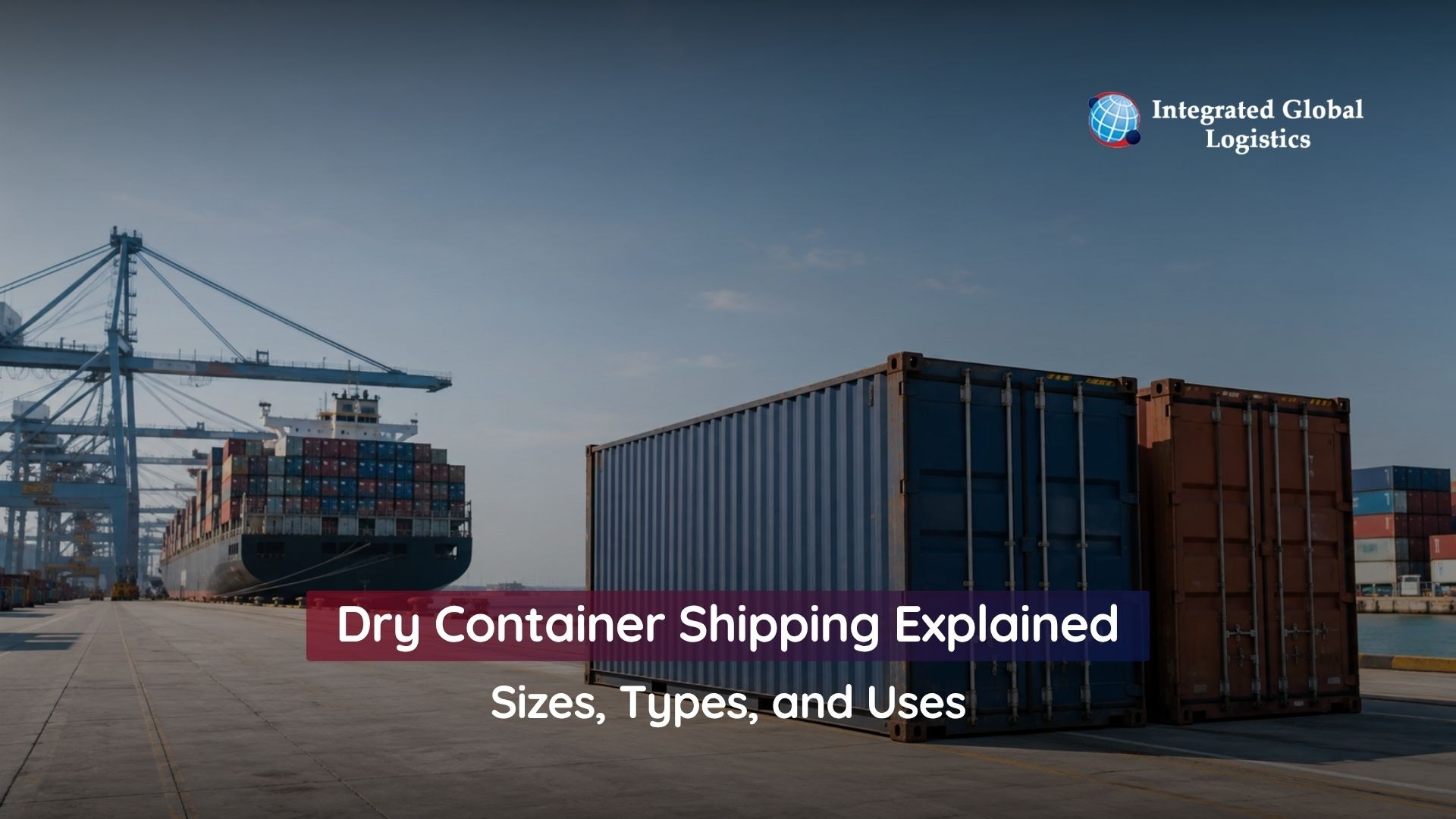
A dry container is a closed steel box used to ship non-temperature-controlled cargo by sea. The three standard sizes are the 20ft, the 40ft, and the 40ft high cube, holding roughly 33, 67, and 76 cubic meters. The 20ft and 40ft standard are about 2.39 meters tall inside, while the high cube is about 2.69 meters. Choose a 20ft for dense, heavy cargo and a 40ft or high cube for lighter, bulkier loads. Dry containers carry most general cargo, from machinery and textiles to packaged goods.
Most of what crosses the ocean travels inside a dry container. It is the plain steel box you see stacked on ships and trucks, and it moves everything from machinery and furniture to clothing and canned food. For an exporter, understanding the standard sizes, what each one holds, and which fits your cargo is one of the simplest ways to ship more efficiently and avoid paying for space you cannot use.
This guide covers dry container shipping from the ground up: what a dry container is, the standard sizes and their real internal dimensions, the main types, the cargo they carry, and how to choose between them. When you later request an ocean freight quote, knowing the right container type is one of the details that gets you an accurate rate the first time.
What Is a Dry Container?
A dry container, also called a general purpose or standard container, is a closed steel shipping container built to carry cargo that does not need temperature control. It has corrugated steel walls, a solid roof, a plywood or bamboo floor, and double doors at one end. It is the workhorse of container shipping and carries the large majority of the world's containerized freight.
The word dry distinguishes it from a reefer, which is refrigerated, and from special-purpose equipment such as open-top or flat-rack containers used for oversized loads. Within the dry category, containers differ mainly by length and height, which is what gives you the standard sizes covered below.
Dry Container Sizes and Dimensions
The table below shows the typical internal dimensions, volume, and weights for the three most common dry containers. Figures vary slightly by manufacturer, container age, and carrier, so use them for planning and confirm exact specs with your carrier before loading.
| Specification | 20ft Standard | 40ft Standard | 40ft High Cube |
|---|---|---|---|
| Internal length | ~5.90 m | ~12.03 m | ~12.03 m |
| Internal width | ~2.35 m | ~2.35 m | ~2.35 m |
| Internal height | ~2.39 m | ~2.39 m | ~2.69 m |
| Cubic capacity | ~33 CBM | ~67 CBM | ~76 CBM |
| Tare weight | ~2,300 kg | ~3,750 kg | ~3,900 kg |
| Max payload | up to ~28,000 kg | up to ~28,000 kg | up to ~28,500 kg |
| Pallets (one layer) | ~10 to 11 | ~20 to 22 | ~20 to 22 |
The 20ft container is the reference unit for the whole industry. One 20ft box equals one TEU, or twenty-foot equivalent unit, which is how ships and ports measure capacity. A 40ft container is counted as two TEU and holds a little over twice the volume of a 20ft, because the 20ft loses proportionally more space to its end structures.
Types of Dry Containers
Within the dry family, the differences come down to length and height. These are the types you will actually be offered for standard cargo.
20ft standard
The compact workhorse. Its smaller footprint and lower tare make it the natural choice for dense, heavy cargo that reaches a weight limit before it fills the space, such as machinery parts, tiles, drums, and canned goods.
40ft standard
The most widely used export box. It offers roughly twice the volume of a 20ft for a smaller increase in cost, which makes it efficient for consistently palletized general cargo of moderate weight.
40ft high cube
A 40ft container with an extra foot of internal height. The added headroom suits tall items and lightweight, bulky cargo where you run out of space before you run out of weight, and it is one of the most popular boxes for volume-heavy shipments.
45ft high cube
A longer high cube that adds length as well as height for the highest volume in the standard range. Availability is more limited than the 20ft and 40ft, so it is worth confirming equipment before planning around it.
Not Sure Which Container Fits Your Cargo?
Integrated Global Logistics moves dry, reefer, and dangerous goods FCL ocean freight from the USA to 50+ countries, with in-house documentation and 99.5% on-time performance. Share your cargo weight and volume and our team will confirm the right container and respond within one business day.
Get Dry Container Shipping HelpWhat Dry Containers Are Used For
Dry containers carry almost any cargo that does not need temperature control. Because they are sealed and weatherproof, they protect goods across a long ocean voyage while remaining simple to load, stack, and handle. Common cargo includes:
- Machinery, industrial equipment, and automotive parts.
- Textiles, apparel, and footwear.
- Electronics and consumer goods.
- Packaged food, beverages, and non-perishable groceries.
- Furniture, building materials, and hardware.
- Freight of all kinds, where mixed general cargo is consolidated.
Some regulated cargo can also move in a dry container but needs extra care. Dangerous goods, for example, travel in standard boxes but require correct classification, and understanding hazardous materials shipping rules is essential before booking that kind of cargo.
Dry vs Reefer Containers
The line between a dry container and a reefer is simple: temperature. If your cargo needs to be held at a set temperature, it needs a reefer. If it does not, a dry container is almost always the more economical choice, because it costs less to move and offers more internal space for the same external size.
The space difference is real. A reefer carries insulation and refrigeration machinery, so a 40ft reefer holds around 60 cubic meters against roughly 67 for a 40ft dry. For frozen, chilled, or otherwise temperature-sensitive goods, though, that trade-off is necessary, and dedicated reefer container shipping is the right path rather than a standard box.
How to Choose the Right Dry Container
The choice comes down to one question: is your cargo limited by weight or by volume? Answer that and the right container is usually clear.
Dense, heavy cargo tends to reach the weight limit of a 20ft container before it fills the space, so a 20ft is efficient and a larger box would simply travel part empty. Lighter, bulkier cargo does the opposite: it fills the space long before it reaches the weight limit, so a 40ft or 40ft high cube carries far more for a modest increase in cost. Tall items point toward the high cube for its extra headroom.
When the decision is close, the practical answer is to calculate your total cargo weight and volume and let those numbers guide the box. An experienced forwarder does this as a matter of course, which is one reason it helps to choose a freight forwarder who plans the load with you rather than simply booking whatever you ask for.
Integrated Global Logistics LLC is a licensed NVOCC and international freight forwarder, founded in 2015, with more than 10 years of experience and 99.5% on-time performance. IGL moves dry, reefer, and dangerous goods FCL ocean freight from the USA with direct carrier contracts, in-house documentation, real-time visibility, and one operations representative from start to finish, across 50+ countries worldwide.
Frequently Asked Questions
What is a dry container?
A dry container, also called a general purpose or standard container, is a closed steel shipping container used to move non-temperature-controlled cargo by sea. It has solid walls, a roof, and double doors at one end, and it carries the large majority of the world's containerized freight, including machinery, packaged goods, textiles, and general merchandise.
What are the standard dry container sizes?
The three most common dry container sizes are the 20ft standard, the 40ft standard, and the 40ft high cube. The 20ft and 40ft standard containers are about 2.39 meters tall internally, while the 40ft high cube is about 2.69 meters, roughly 30 centimeters taller. A 45ft high cube is also available for extra length. The 20ft container equals one TEU, the standard unit used to measure container volume.
How much can a 20ft dry container hold?
A 20ft dry container has an internal volume of approximately 33 cubic meters and typically carries a payload of up to around 28,000 kilograms, though the exact maximum depends on the container build, the carrier, and road weight limits. It fits roughly 10 to 11 standard pallets on a single floor level and is often the best choice for dense or heavy cargo that would reach a weight limit before filling a larger box.
What is the difference between a standard and high cube container?
A high cube container is about 30 centimeters, or one foot, taller than a standard container of the same length, with an internal height of roughly 2.69 meters instead of 2.39 meters. On a 40ft box this adds around 8 to 9 cubic meters of volume. High cube containers suit tall or lightweight bulky cargo where volume runs out before weight, while standard containers suit denser loads.
What is the difference between a dry container and a reefer container?
A dry container carries non-temperature-controlled cargo, while a reefer container is refrigerated and holds a programmed temperature for perishable or temperature-sensitive goods. Because a reefer has insulation and refrigeration machinery, it has less internal space than a dry container of the same external size. A 40ft reefer holds roughly 60 cubic meters against about 67 for a 40ft dry.
What cargo can you ship in a dry container?
Dry containers carry the majority of general cargo: machinery and equipment, textiles and apparel, electronics, packaged food and beverages, furniture, building materials, automotive parts, and freight of all kinds. They suit any non-perishable cargo that does not need temperature control. Certain regulated goods, such as dangerous goods, can move in a dry container but require additional classification and documentation.
How many pallets fit in a dry container?
A 20ft dry container fits approximately 10 to 11 standard pallets on a single floor level, and a 40ft container fits about 20 to 22. The exact number depends on the pallet size, how the cargo is stacked, and whether double stacking is possible within the height and weight limits. Planning the pallet layout is one of the most effective ways to maximize container use.
How do I choose between a 20ft and 40ft container?
Choose based on whether your cargo is limited by weight or by volume. Dense, heavy cargo often reaches the weight limit of a 20ft container before filling it, making the 20ft the efficient choice. Lighter, bulkier cargo fills the space before hitting the weight limit, so a 40ft or 40ft high cube carries more for the money. A freight forwarder can confirm the best fit from your cargo weight and volume.
IGL Freight Intelligence
IGL's Freight Intelligence content is produced by IGL's operations and ocean freight teams specializing in dry, reefer, and dangerous goods FCL ocean freight, container planning, and inland trucking across 50+ countries. (732) 250-9000 | info@integratedgl.com