
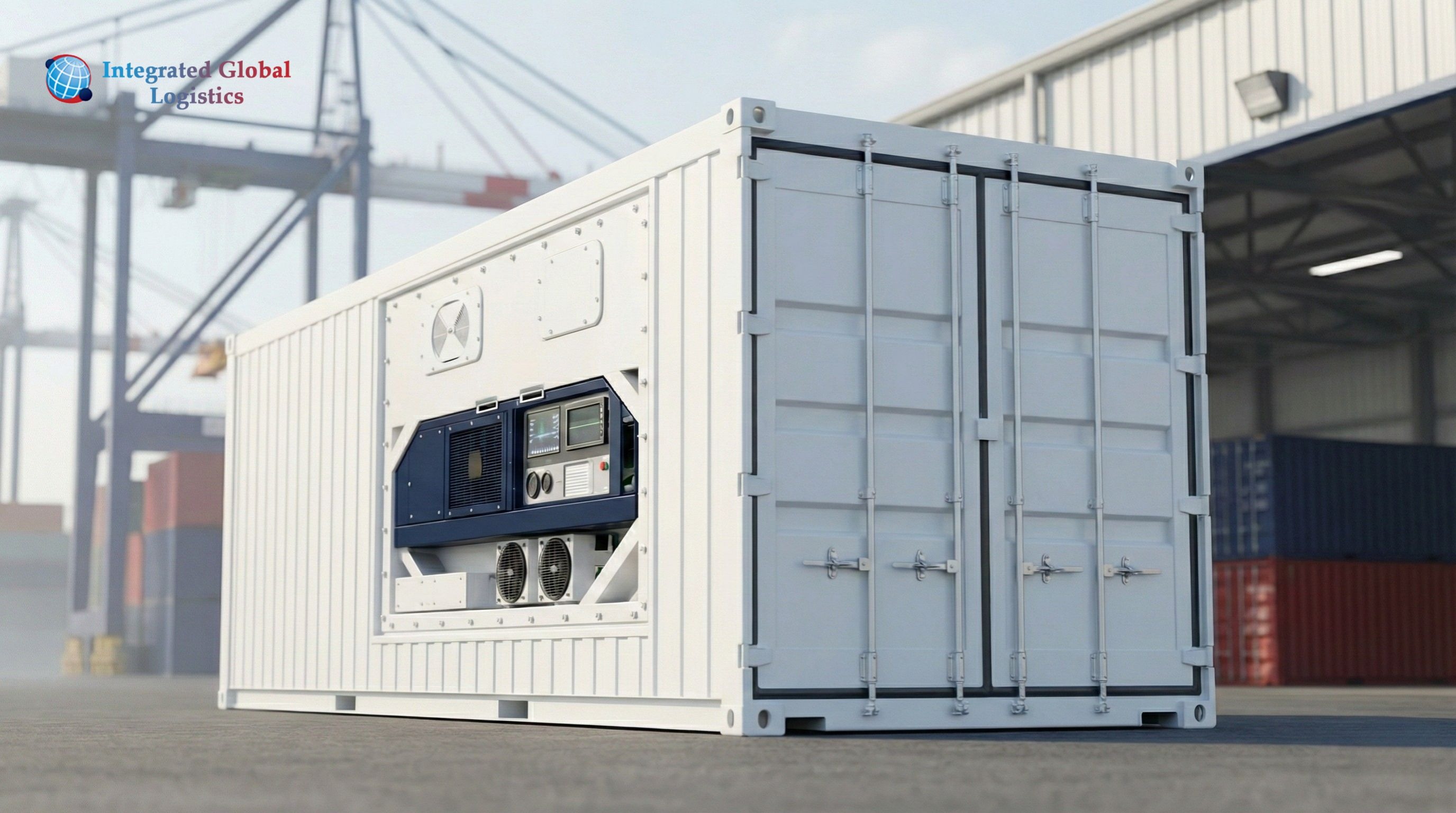
What Is Reefer Truckload Shipping?
Reefer truckload shipping is the transport of temperature-sensitive cargo in a single refrigerated trailer, where one shipper takes the full trailer capacity for a dedicated, direct-to-destination move. The trailer is equipped with a diesel-powered refrigeration unit mounted at the front that actively maintains a set temperature throughout transit, regardless of external conditions.
Unlike a dry van, which offers no temperature control whatsoever, a reefer trailer functions as a mobile temperature-controlled environment. The refrigeration unit can maintain temperatures ranging from approximately -20 degrees Fahrenheit for frozen cargo up to +65 degrees Fahrenheit for cargo requiring cool but not frozen conditions. This range makes reefer truckload the primary transport mode for frozen meat, chilled produce, dairy, seafood, pharmaceuticals, and any perishable that cannot tolerate ambient temperatures during ground transport.
A full truckload arrangement means the shipper's freight does not share trailer space with other shippers' cargo. This matters for cold chain integrity because multi-stop or consolidation loads introduce open-door events and mixed temperature requirements that create risk for temperature-sensitive freight. IGL's domestic refrigerated cargo operations are structured around dedicated, single-shipper loads precisely because the integrity of the cold chain should never be compromised by operational convenience.
A reefer trailer is designed to maintain a pre-set temperature, not to reduce the temperature of warm cargo after loading. Every piece of freight must arrive at the loading point already at the required temperature. Warm product placed into a pre-cooled trailer will raise the internal ambient temperature and can cause a thermal excursion before the unit has time to compensate.
Reefer vs. Dry Van: When Temperature Control Is Required
The decision between a reefer trailer and a dry van is not always as obvious as it appears. Some shippers incorrectly assume that certain commodities can tolerate a dry van move in cooler seasons or shorter lanes. This is a risk calculation that frequently results in cargo damage, product rejection, or insurance disputes.
Reefer truckload is the correct equipment choice any time the cargo must remain within a defined temperature range from origin to destination, without exception. The qualifying factors include the commodity's thermal sensitivity, transit time, seasonal ambient temperatures across the route, and any food safety or pharmaceutical regulatory requirements that mandate documented temperature control.
| Criteria | Reefer Truckload | Dry Van Truckload |
|---|---|---|
| Temperature Control | Active mechanical control, -20°F to +65°F | None — ambient temperature only |
| Data Logging | Continuous temperature recording throughout transit | Not available |
| Cargo Types | Frozen food, chilled produce, dairy, meat, pharma, seafood | Non-perishable dry goods only |
| FSMA Compliance | Eligible when carrier follows sanitary practices | Not eligible for temperature-controlled cargo |
| Cost vs. Dry Van | Higher due to specialized equipment and fuel | Lower baseline cost |
| Pre-Trip Inspection | Required — refrigeration unit must be validated | Standard trailer inspection only |
For shippers moving food products regulated under the FDA's Food Safety Modernization Act (FSMA) Sanitary Transportation Rule, using a dry van for temperature-sensitive cargo is not just a quality risk. It can constitute a regulatory violation that exposes both shipper and carrier to enforcement action.
Refrigerated Trailer Types and Equipment
Not all refrigerated trailers are configured the same way, and the equipment specification matters for both temperature performance and cargo handling. Understanding the primary trailer types and their operational characteristics allows shippers to specify the correct equipment at booking rather than discovering a mismatch at pickup.
Standard 53-Foot Refrigerated Trailer
The 53-foot refrigerated trailer is the workhorse of domestic reefer truckload shipping in the USA. It provides approximately 2,800 cubic feet of internal volume and a payload capacity of roughly 42,000 to 44,000 pounds. This is the appropriate equipment for the majority of full truckload frozen and chilled food shipments moving between distribution centers, port facilities, processing plants, and cold storage warehouses.
48-Foot Refrigerated Trailer
The 48-foot trailer offers slightly less capacity than a standard 53-foot unit and is less common in the market, though it remains in service with certain regional carriers. It is suitable for loads that do not require full 53-foot capacity and where lane-specific carrier relationships exist.
Multi-Temperature Trailers
Some refrigerated trailers are equipped with a movable bulkhead that allows the trailer to be divided into two compartments operating at different set-point temperatures simultaneously. This is relevant only in rare cases where a shipper needs to co-load two product types requiring different temperature ranges under a single dedicated contract. For standard reefer truckload operations, a single-zone trailer is the norm.
Refrigeration Unit Standards
The quality and age of the refrigeration unit directly affects temperature performance. Leading-generation refrigeration units from manufacturers such as Thermo King and Carrier Transicold offer tighter temperature tolerances, faster pull-down times after door openings, and more reliable continuous operation than older equipment. When qualifying carriers, asking specifically about refrigeration unit model and vintage is a legitimate part of the equipment review process.
All professional reefer truckload carriers maintain an onboard data logger that records the trailer's internal temperature at regular intervals throughout the shipment. This record is the primary documentation tool for verifying cold chain compliance during transit and is essential for food safety audits, insurance claims, and buyer acceptance at destination. Always request the logger download as part of proof of delivery for temperature-sensitive loads.
Temperature Requirements by Commodity
Temperature set points in reefer truckload shipping are not interchangeable across commodity types. Each product category has a defined optimal range, and deviations above or below that range carry distinct spoilage or safety risks. The table below provides reference set points for the most common temperature-sensitive freight categories moved domestically in the USA.
These are indicative ranges. Actual set points must always be confirmed with the shipper's food safety team, the buyer's receiving specifications, and any applicable USDA or FDA requirements for the commodity class.
| Commodity | Recommended Set Point | Risk of Deviation |
|---|---|---|
| Frozen beef / pork / lamb | 0°F (-18°C) | Above 10°F (-12°C): USDA frozen standard violation |
| Fresh chilled beef | 28°F to 32°F (-2°C to 0°C) | Narrow tolerance; above 40°F triggers FSMA action |
| Frozen poultry | 0°F (-18°C) | USAPEEC and USDA standards apply; core temp critical |
| Fresh shell eggs | 45°F (7°C) or below | FSMA requires refrigeration at or below 45°F post-packaging |
| Fresh seafood (chilled) | 32°F to 36°F (0°C to 2°C) | Short shelf life; each hour above range is critical |
| Frozen seafood | 0°F to -13°F (-18°C to -25°C) | Super-frozen tuna requires specialty equipment |
| Fresh produce (general) | 34°F to 50°F (1°C to 10°C) | Varies by variety; chilling injury possible below range |
| Dairy (fluid milk) | 35°F to 38°F (2°C to 3°C) | FSMA Grade A standards require continuous refrigeration |
| Cheese and butter (frozen) | 0°F (-18°C) | Texture and flavor damage above threshold |
| Pharmaceuticals (cold chain) | 36°F to 46°F (2°C to 8°C) | GDP validation required; excursions may void efficacy |
How to Execute a Reefer Truckload Shipment: Step by Step
Cold chain failures in domestic reefer truckload almost always trace back to one of three points: inadequate pre-cooling, a loading error, or a carrier that was not properly qualified for the commodity. The following eight-step process addresses each of these failure points in sequence.
Confirm Temperature Specifications with Shipper and Receiver
Before booking, obtain written confirmation of the required temperature set point, acceptable variance, and any specific handling instructions from both the shipper and the receiving facility. Discrepancies between shipper and receiver specifications must be resolved before the load is booked, not at delivery. Also confirm the receiver's dock capabilities, pre-cooling requirements at delivery, and any phytosanitary or food safety inspection requirements at the destination.
Select and Book the Correct Equipment
Book a qualified carrier with a trailer that matches the commodity's temperature requirements, capacity needs, and transit timeline. Specify the refrigeration set point, the trailer size, and whether a pre-trip inspection (PTI) report is required at pickup. For pharmaceutical or high-value food loads, request documentation of the refrigeration unit's last maintenance service date and temperature calibration record.
Require a Pre-Trip Inspection
A pre-trip inspection verifies that the refrigeration unit is functioning correctly before the trailer is presented for loading. The PTI should include a check of the refrigeration unit's temperature performance at the required set point, inspection of door seals and gaskets, verification of the data logger's function, and a review of the trailer's interior for cleanliness and damage. Do not allow loading to begin on a trailer that has not completed a satisfactory PTI.
Pre-Cool the Trailer to Set-Point Temperature
Pre-cool the trailer to the required set-point temperature for a minimum of two hours before loading begins. Verify the pre-cooled temperature by checking the trailer's return air temperature reading, not the supply air reading, which can be artificially low. A trailer that reads the correct supply air temperature but has not actually reached set point throughout the interior is a common PTI error that creates risk at loading.
Load Pre-Conditioned Cargo with Correct Airflow Clearance
Load only cargo that is already at the required temperature. Verify product temperatures with a calibrated probe thermometer before the first pallet enters the trailer. Load cargo to maintain clearance on the floor channels and avoid blocking the return air bulkhead at the front of the trailer. Restricted airflow is one of the primary causes of hot spots and uneven temperature distribution in refrigerated loads.
Set and Verify All Refrigeration Parameters Before Departure
After loading is complete and the trailer is sealed, verify that the refrigeration unit is set to the correct temperature, the data logger is active and recording, and any continuous-run mode settings are configured correctly for the commodity type. For frozen loads, confirm the unit is in continuous-run mode rather than cycle-sentry mode, which allows the unit to shut down between cycles and can create temperature drift.
Monitor Temperature Throughout Transit
For lanes longer than eight hours, use a carrier that provides remote temperature monitoring capability or supplement the trailer's onboard logger with an independent temperature monitor that transmits real-time alerts. Define a response protocol before departure: who receives temperature alerts, what the escalation procedure is if an excursion is detected during transit, and what authority the carrier or logistics provider has to make routing decisions in the event of a refrigeration unit failure.
Document and Verify at Delivery
At delivery, obtain the data logger download before the trailer is unsealed if possible, or immediately upon opening. Verify product temperatures at the receiving dock with a calibrated probe before any product is transferred to the receiving facility's storage. Document any discrepancies between the agreed set point and actual transit temperatures and photograph any visible product condition issues before the receiver takes possession. A signed proof of delivery without temperature verification is insufficient documentation for a cold chain shipment.
Qualifying Reefer Carriers in the USA
In domestic reefer truckload, carrier selection is a compliance decision, not just a cost decision. A carrier that cannot demonstrate the operational practices required to protect temperature-sensitive freight is a liability regardless of how competitive their rate is. The following criteria represent the minimum qualification standard for reefer carriers handling food, pharmaceutical, or other regulated temperature-sensitive cargo.
FSMA Sanitary Transportation Compliance
The FDA's FSMA Sanitary Transportation of Human and Animal Food rule establishes legal requirements for vehicles, equipment, transportation operations, training, and records when transporting food. Carriers must have written sanitary transportation procedures, training records for drivers, and documented equipment cleaning and sanitation records. Shippers who use carriers that cannot produce these records assume regulatory risk.
Temperature Data Logger Records
Any carrier operating in temperature-sensitive freight should be able to produce historical data logger records on request. A pattern of temperature excursions in a carrier's historical records is a disqualifying finding regardless of any explanation offered. A carrier that cannot produce historical records is equally disqualified.
Refrigeration Unit Age and Maintenance Records
Refrigeration unit reliability is directly related to maintenance discipline. Ask for the unit's last service date and any recorded breakdown history on the specific equipment being offered for your load. Carriers with documented preventive maintenance programs present substantially lower equipment failure risk than those running reactive maintenance only.
Driver Training and Communication
The driver operating a reefer load needs to understand the cargo's temperature requirements and the correct response if a refrigeration alarm is triggered during transit. Confirm that the carrier's drivers receive specific training on reefer operations and that the driver assigned to your load has verifiable experience with temperature-sensitive freight, not just general truckload experience.
Integrated Global Logistics maintains a carrier qualification process for domestic refrigerated freight that covers equipment standards, FSMA compliance documentation, temperature record history, and driver training verification. Shippers who work with IGL for domestic temperature-controlled moves are not picking a carrier off a load board. They are accessing a vetted carrier network built specifically for cold chain freight performance.
US Reefer Lanes and Capacity Considerations
Domestic reefer capacity in the USA is not uniformly distributed across lanes and seasons. Understanding where capacity tightens, and when, is a practical planning tool for shippers who need consistent access to refrigerated equipment without paying premium spot rates at short notice.
High-Volume Reefer Corridors
The highest-volume domestic reefer lanes in the USA follow the geography of food production and distribution. California remains the origin for a significant share of domestic fresh produce reefer freight, with high-volume outbound lanes to major consumption markets in the Southeast, Midwest, and Northeast. Florida generates strong citrus, tropical produce, and seafood reefer volumes. The Midwest produces frozen meat and dairy that moves eastbound and southbound in large volumes. Texas serves as both a production origin and a pass-through hub for cross-border and Gulf Coast freight.
Seasonal Capacity Constraints
Reefer capacity tightens predictably during certain seasonal periods. California produce harvests in late spring through early fall create sustained demand that regularly exceeds available supply of refrigerated equipment in the region. Holiday periods ahead of major US food consumption events, including Thanksgiving, Christmas, and July Fourth, generate demand spikes across multiple commodity types simultaneously. Shippers who have not secured capacity commitments before these windows typically face significantly higher spot rates and service risk.
Port-Adjacent Reefer Freight
US export shippers who use reefer truckload to move product from production facilities to port terminals face specific capacity dynamics at port gateways. Los Angeles/Long Beach, New York/New Jersey, Miami, and Houston all have active reefer container export programs, and the drayage and short-haul reefer capacity serving these terminals operates on tight timelines driven by vessel schedules and port cut-offs.
Shipping Temperature-Sensitive Freight Across the USA?
IGL's domestic refrigerated cargo service covers the full execution process, from carrier qualification and PTI verification to real-time monitoring and delivery documentation. Talk to our team about your lane and commodity.
Get a Reefer QuoteCompliance and Documentation for Temperature-Sensitive Freight
Domestic reefer truckload operates under a more substantial regulatory framework than many shippers recognize. The combination of FDA food safety requirements, USDA commodity-specific standards, and carrier-level compliance obligations creates a compliance environment that demands documentation discipline at every stage of the shipment.
FSMA Sanitary Transportation Rule
The FDA Food Safety Modernization Act Sanitary Transportation Rule, effective since 2017, places legal obligations on shippers, carriers, loaders, and receivers involved in the transportation of human and animal food. Shippers are responsible for specifying temperature requirements to the carrier in writing, for ensuring that any temperature controls specified are adequate for the food being transported, and for verifying that the carrier's sanitary practices meet the rule's standards. These are not recommendations. They are enforceable legal requirements.
USDA Commodity-Specific Standards
Certain commodity types, including beef, poultry, and eggs, are subject to USDA standards that include temperature requirements during transport. USDA-inspected product that is transported above the maximum allowable temperature for its product class can be subject to regulatory action at destination. Shippers of USDA-inspected product should confirm that their reefer truckload carrier is familiar with the applicable temperature standards for the specific commodity class being moved.
Documentation for Temperature-Sensitive Loads
The minimum documentation package for a domestic reefer truckload shipment should include the bill of lading specifying the temperature requirement, a record of the PTI results and trailer pre-cool temperature at loading, the carrier's written temperature specification acknowledgment, a continuous data logger record covering the full transit duration, and a delivery receipt documenting temperature verification at the receiving point. Shippers who maintain this documentation package consistently are substantially better positioned in the event of a cargo claim or regulatory inquiry.
Connecting Domestic Reefer to International Ocean Freight
For US exporters, domestic reefer truckload is frequently the first mile of a longer international cold chain that ultimately moves product to buyers in markets across the Middle East, Southeast Asia, Europe, or Latin America. The integration between the domestic reefer leg and the international ocean leg is a point of significant operational risk that is often managed poorly when the two are handled by different providers who do not communicate effectively.
The domestic reefer truck must deliver product to the port terminal or container freight station within the vessel's cut-off window. Port terminals impose strict appointment systems and receiving hours for reefer containers, and a reefer truck that misses a terminal appointment due to a breakdown, traffic delay, or administrative error can cascade into a missed sailing that costs the shipper a full week or more of transit time. For perishable exports with defined shelf life windows, this can mean a lost sale.
IGL manages the full cold chain for US exporters, coordinating the domestic refrigerated trucking leg through its refrigerated cargo service and the international ocean freight leg through its FCL reefer container program. This single-provider coordination model eliminates the communication gap between domestic and ocean providers that creates missed cut-offs and documentation errors. When both legs are managed under one accountable partner, the handoff between truck and vessel is a managed process, not a point of uncertainty.
Exporters moving frozen meat, poultry, dairy, or seafood internationally should also consider that the stuffing of the ocean reefer container at port must follow the same pre-cooling and loading discipline as the domestic truck load. A reefer container is not pre-cooled by default when it is delivered to a port terminal. The pre-trip inspection and pre-cooling of the ocean container must be coordinated with the shipping line and the terminal in advance. IGL's complete guide to international reefer container shipping covers this process in detail for exporters planning the ocean leg of their cold chain.
For US exporters who are newer to the full container load process, understanding the distinction between the domestic truck leg and the ocean freight leg is foundational. IGL's guide on how to ship FCL from the USA provides the broader framework for exporters building their first or next international cold chain program.
Shippers who need both full truckload capacity for domestic moves and FCL ocean freight for international shipments can consolidate both under IGL's full truckload shipping and ocean freight services, which are coordinated through a single account management structure. This eliminates the administrative overhead of managing multiple providers across domestic and international legs and provides a unified chain of custody record from the production facility to the international buyer.
Managing Both Domestic and International Cold Chain?
IGL coordinates domestic reefer truckload and international FCL reefer container shipping under a single accountable partner. From production facility to destination buyer, no cold chain handoff is left unmanaged.
Talk to Our TeamFrequently Asked Questions
What is reefer truckload shipping?
Reefer truckload shipping is the domestic transport of temperature-sensitive freight in a full refrigerated trailer, where one shipper occupies the entire trailer capacity. The trailer is equipped with a diesel-powered refrigeration unit that maintains a precise temperature throughout transit. It is used for frozen and chilled food, pharmaceuticals, dairy, produce, and other cargo that requires continuous temperature control from pickup to delivery.
What temperature ranges can reefer trucks maintain in the USA?
Standard refrigerated trailers in the USA can maintain temperatures from approximately -20 degrees Fahrenheit (-29 degrees Celsius) for frozen freight up to +65 degrees Fahrenheit (+18 degrees Celsius) for temperature-protected cargo. Most units operate with a tolerance of plus or minus 2 to 3 degrees Fahrenheit. Cargo requiring precise narrowband temperature control, such as pharmaceuticals, requires carriers with validated equipment and continuous data logging.
What is the difference between reefer truckload and dry van truckload?
A reefer truckload uses a refrigerated trailer with an active mechanical cooling unit to maintain a specific temperature during transit. A dry van truckload uses an unrefrigerated enclosed trailer with no temperature control. Reefer trailers are required for any cargo that must remain at a controlled temperature throughout domestic transport, including frozen food, fresh produce, dairy, meat, seafood, and pharmaceuticals.
Do I need to pre-cool the reefer trailer before loading?
Yes. Pre-cooling the trailer to the required set-point temperature before loading is a non-negotiable step in reefer truckload shipping. A reefer unit is designed to maintain a pre-set temperature, not to reduce the temperature of warm cargo after loading. Loading ambient-temperature product into an inadequately pre-cooled trailer is one of the most common causes of temperature excursions in domestic refrigerated freight.
What commodities are most commonly shipped via reefer truckload in the USA?
The most common reefer truckload commodities in the USA include frozen and chilled beef, pork, and poultry; fresh produce and fruits; dairy products including butter, cheese, and fluid milk; fresh and frozen seafood; pharmaceutical and healthcare products; and temperature-sensitive food ingredients and beverages. Each commodity has specific temperature requirements and handling protocols that must be confirmed with the carrier before booking.
Can reefer truckload freight connect to international ocean shipments?
Yes. Reefer truckload is a critical first or last mile for international reefer container shipments. Cargo picked up from a production facility or warehouse is transported by refrigerated truck to a port terminal or CFS, where it is stuffed into an ocean reefer container for export. Integrated Global Logistics coordinates both the domestic refrigerated trucking leg and the international ocean freight leg for exporters moving temperature-sensitive cargo from US origins to global destinations.