
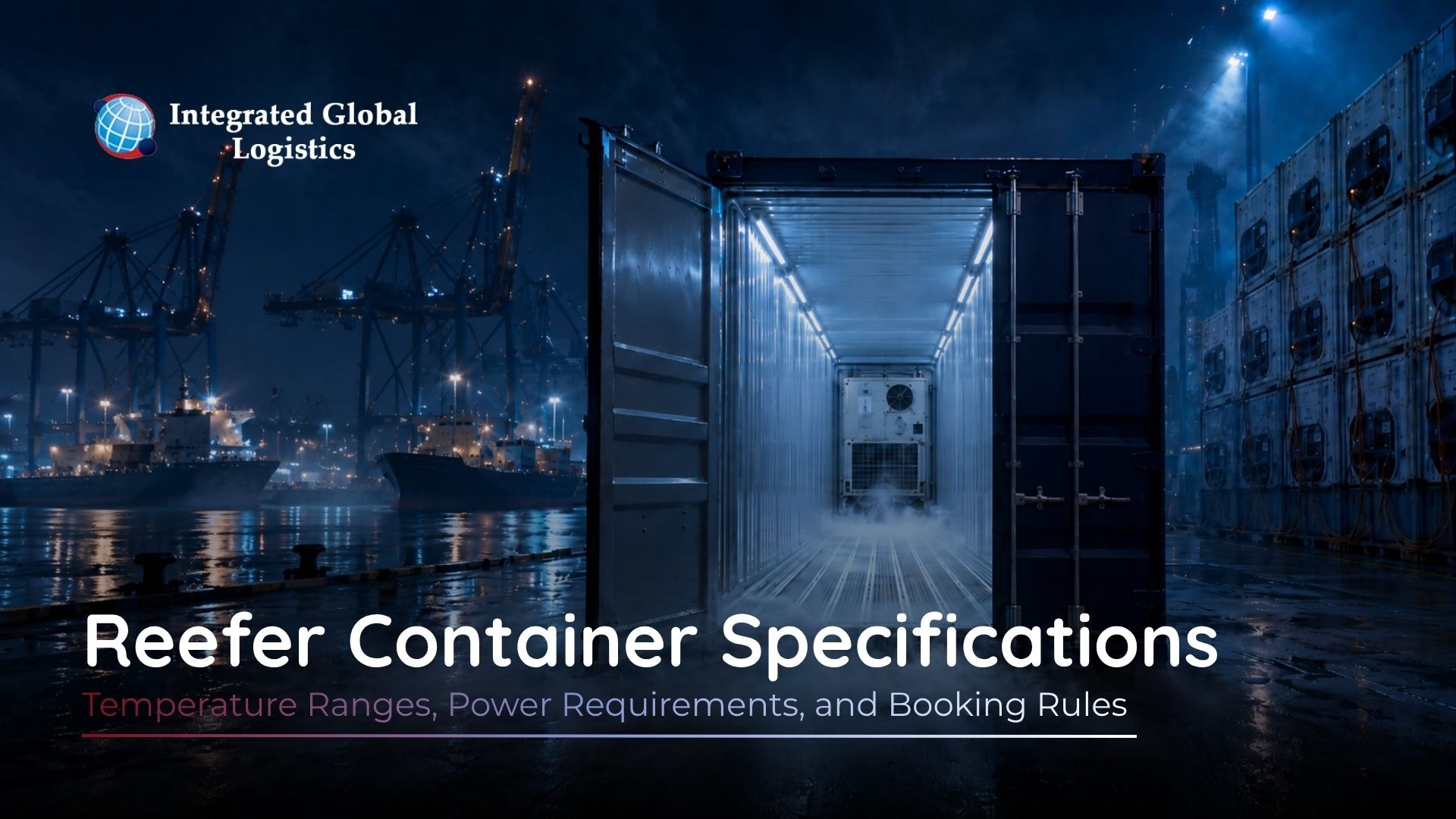
A standard reefer container maintains temperatures from -30°C to +30°C, with the set-point declared at booking and maintained at ±0.5°C accuracy throughout transit. The three primary cargo temperature categories are frozen (-25°C to -18°C), chilled (0°C to +4°C), and controlled atmosphere (0°C to +14°C, commodity-dependent). Power at US ports is 440V, 3-phase, 60Hz, with vessel reefer plugs providing power at sea. At booking, shippers must declare the commodity, set-point, ventilation settings, humidity requirements, and whether a genset is needed. The single most important rule: cargo must be pre-cooled to the required temperature before loading begins. A reefer container maintains temperature; it does not chill warm product.
Reefer containers carry frozen protein, fresh produce, pharmaceuticals, and perishable food products, cargo where a two-degree temperature excursion can trigger a regulatory rejection or cargo loss. The specifications that govern a reefer shipment are set before the container leaves the depot, not after the vessel departs.
Most temperature excursions in international cold chain shipping trace back to one of four points: wrong set-point declared at booking, cargo loaded warm, power interruption at a port transfer, or ventilation settings mismatched to the commodity. All four are preventable. This guide covers what the correct specifications are, why they matter, and what shippers need to declare when booking FCL shipping with a reefer container.
Reefer Container Sizes and Internal Specifications
Three standard reefer container sizes are used in international ocean freight. Selecting the correct size affects cargo fit, airflow inside the container, and the power draw required throughout the voyage.
| Container Type | External Dimensions | Internal Volume | Max Payload | Common Use |
|---|---|---|---|---|
| 20-foot reefer | 20' x 8' x 8'6" | ~28 CBM | ~21,000 kg | Dense, heavy cargo: frozen seafood, frozen meat blocks |
| 40-foot reefer | 40' x 8' x 8'6" | ~62 CBM | ~27,000 kg | Standard for frozen and chilled cargo across most commodities |
| 40-foot high-cube reefer | 40' x 8' x 9'6" | ~72 CBM | ~26,000 kg | High-volume, lower-density cargo: fresh produce, cut flowers, pharmaceuticals |
The 40-foot high-cube reefer is the most commonly booked container for US fresh produce and agricultural exports. The additional 12 inches of internal ceiling height allows taller pallet configurations and reduces the risk of crushing damage on produce packed above standard stack height. For dense frozen cargo where cubic volume is not the constraint, the standard 40-foot reefer is typically sufficient and may offer better power efficiency at sub-zero set-points.
Internal airflow is critical in all three sizes. Cargo must be loaded to allow air circulation through the T-floor (the aluminium floor channel system that distributes cool air from the front bulkhead to the rear). Blocking the T-floor with incorrectly stacked cargo or floor-level packaging is a common source of warm spots that do not appear on the container's temperature sensor but affect cargo in the blocked zones.
Temperature Ranges by Cargo Category
Reefer containers can maintain temperatures across a broad spectrum, but each commodity has a defined required set-point. Declaring the wrong set-point at booking is not correctable once the vessel is at sea.
| Temperature Category | Set-Point Range | Typical Commodities |
|---|---|---|
| Super frozen | -60°C to -25°C | Sashimi-grade tuna, specialty seafood |
| Frozen | -25°C to -18°C | Beef, pork, chicken, fish, ice cream, frozen vegetables |
| Deep chilled | -5°C to -1°C | Fresh fish, unprocessed fresh meat |
| Chilled | 0°C to +4°C | Dairy, processed fresh meat, fresh poultry, cheese |
| Pharmaceutical cold chain | +2°C to +8°C | Vaccines, biologics, temperature-sensitive medications |
| Controlled atmosphere | 0°C to +14°C (commodity-dependent) | Apples, avocados, bananas (+13°C to +14°C), citrus, berries |
| Ambient protected | +10°C to +15°C | Wine, chocolate, some tropical fruits |
Commodity Set-Points for US Food Exporters
For US exporters of regulated food products, the set-point must comply with USDA Food Safety and Inspection Service (FSIS) and FDA requirements for the specific commodity. The figures below represent the standard operating set-points used in US cold chain export practice.
| Commodity | Set-Point | Regulatory Note |
|---|---|---|
| Frozen beef | -18°C | USDA FSIS export certification required |
| Fresh beef | 0°C to +2°C | Must be pre-chilled to set-point before loading |
| Frozen chicken and poultry | -18°C | USAPEEC export guidelines apply |
| Fresh poultry | 0°C to +2°C | Direct routing preferred; limited transit window |
| Frozen fish and seafood | -18°C to -22°C | Species-dependent; confirm with NMFS where applicable |
| Fresh fish | -1°C to +2°C | Narrow margin; transit time is critical |
| Dairy (pasteurized) | 0°C to +4°C | FDA Prior Notice required for US imports |
| Fresh produce (general) | 0°C to +8°C | Commodity-specific; confirm before booking |
| Bananas | +13°C to +14°C | CA recommended; ethylene management required |
| Pharmaceuticals | +2°C to +8°C | GDP compliance documentation required |
For US exporters of cold chain logistics companies serve the full compliance documentation chain alongside the temperature-controlled movement itself. The set-point alone does not satisfy regulatory requirements: USDA FSIS health certificates, FDA Prior Notice filings, and phytosanitary certificates must be coordinated for the commodity category and destination country before the shipment moves.
Power Requirements and Electrical Standards
A reefer container runs continuously from pre-cooling at the depot through vessel transit to delivery. A power interruption of even a few hours at a terminal transfer can create an unrecoverable temperature excursion for frozen or pharmaceutical cargo.
At US origin ports
Reefer containers at US marine terminals plug into the terminal's reefer stack power supply: 440V, 3-phase, 60Hz. While awaiting vessel loading, the container draws power from the terminal's electrical infrastructure and should be monitored for set-point compliance during the waiting period.
At sea
The vessel provides power through dedicated reefer plug sockets built into the deck structure. Each vessel has a defined number of reefer slots, and carriers confirm plug availability when accepting a reefer booking. On high-demand trade lanes during peak seasons, reefer plug capacity constraints can limit the carrier's ability to accept additional reefer bookings, which is one reason early booking is important for cold chain shippers.
At international destination ports
Destination power standards vary by country. Many international ports operate at 380V to 440V at 50Hz rather than the 60Hz standard used in the United States. Standard reefer container refrigeration units accommodate both frequencies, but any frequency mismatch in older equipment or non-standard terminal configurations must be confirmed before the shipment is booked. Logistics providers with established port relationships at the destination, particularly New Jersey and Florida East Coast operations, typically have pre-confirmed power compatibility information for the trade lanes they regularly operate.
Genset containers
When shore-side reefer power is unavailable at a transit or destination location, a genset unit clips onto the container to provide self-contained electrical power from an integrated diesel generator. Gensets are required when the container moves by road or rail on a leg without a powered reefer trailer, when intermediate transshipment ports have limited reefer plug infrastructure, or when the final delivery location does not have reefer electrical connections. Genset requirements must be declared at booking; they cannot be added after the container has been dispatched.
Power draw by temperature category is a practical consideration for carriers managing reefer plug loads on vessels: frozen cargo running at -18°C draws significantly more power than chilled cargo at +4°C. On multi-commodity vessels, carriers manage total reefer power loads across all plugged containers.
The Pre-Cooling Rule: The Most Misunderstood Requirement in Reefer Shipping
This single operational requirement is responsible for a significant share of reefer cargo losses in international cold chain shipping, and it is consistently the least understood by first-time reefer shippers.
A reefer container maintains temperature. It does not chill warm cargo. The refrigeration unit manages heat exchange between the interior cargo environment and the outside air through the container walls and door seals. It is engineered for maintenance, not for rapid temperature reduction of a dense load of ambient-temperature product. Loading a full pallet of room-temperature beef into a reefer set to -18°C and expecting the container to freeze it during a 30-day voyage is a fundamental misapplication of the equipment.
The correct pre-cooling procedure before loading:
- Pre-cool the reefer container itself to the required set-point at least two to four hours before cargo loading begins
- Confirm the set-point on the container's temperature controller display matches the booking declaration
- Bring all cargo to the required temperature in a shore-based cold store or blast freezer before any of it is loaded
- Load the pre-cooled cargo rapidly, minimizing door-open time during the loading operation
- Seal the container immediately after loading and verify the temperature inside is maintained at set-point
- Request and retain the PTI (Pre-Trip Inspection) certificate from the carrier confirming the unit was tested before dispatch
The PTI certificate is the documentary proof that the reefer unit was inspected and running correctly before the container reached the shipper's facility. Any reefer shipment moving without a PTI certificate has an unverified starting condition, which complicates any cargo claim that arises during transit.
For the domestic leg from origin cold store to port terminal, the reefer truckload vehicle must also be pre-cooled and running before loading. The cold chain begins at the moment cargo leaves the controlled environment of the cold store, not at the port terminal.
What to Declare When Booking a Reefer Container
Every piece of information below must be declared at the time of booking. Changes after vessel departure are not possible, and changes after the booking confirmation may not be accommodated depending on the carrier and trade lane.
- Commodity and HS code: Determines the applicable regulatory requirements (USDA FSIS, FDA, USAPEEC, phytosanitary) and the required set-point range. The HS code also affects customs documentation at origin and destination.
- Temperature set-point (in Celsius): The exact target temperature, not a range. The carrier programs this into the container controller. If the set-point range for a commodity spans multiple degrees, confirm the precise figure with the buyer's specification or the regulatory requirement for the destination market.
- Ventilation setting: Whether the vent should be open (for fresh produce requiring fresh air exchange) or closed (for frozen cargo and pharmaceuticals). Ventilation rate for produce is measured in cubic feet per hour (CFH) and varies by commodity. Bananas, for example, require specific ventilation to manage ethylene gas buildup.
- Humidity requirements: Fresh produce, cut flowers, and pharmaceutical cargo may specify a relative humidity range. Standard reefer units control temperature by default; humidity management requires specific equipment or settings confirmed at booking.
- Controlled atmosphere requirements: CA modifies the oxygen and CO2 levels inside the container and requires specialized equipment. Not all carriers support CA on all routes. This must be requested and confirmed at booking, not assumed.
- Genset requirement: If the cargo will travel by road from the cold store to the port without a powered reefer trailer, or if the destination requires genset power, this must be declared so the carrier can arrange the equipment.
- Cargo dimensions and pre-cooled temperature at loading: Standard for all FCL bookings, but critical for reefer to confirm cargo fits within airflow requirements and that the loading temperature will be confirmed on the PTI or a shipper's temperature declaration.
For US food exporters, the required USDA, FDA, and phytosanitary documentation must be confirmed at the time of booking as well. These cannot be prepared after vessel departure and may require lead time of several days to weeks depending on the commodity and destination country requirements.
Temperature Monitoring and Documentation During Transit
Temperature data logging is continuous throughout a reefer container's voyage. The container's internal datalogger records temperature at regular intervals, typically every 15 to 60 minutes, and this data is available at destination for review. Carriers provide the temperature download as part of the delivery documentation on request.
Key documentation that should accompany every reefer FCL shipment:
- PTI certificate: Pre-trip inspection report from the carrier, confirming the reefer unit's condition and pre-cooling status before dispatch
- Temperature download printout: Full transit temperature log from the container's datalogger, available at destination
- Container condition report: Inspection record noting the container's physical state at time of loading
- USDA FSIS export health certificate: For meat and poultry exports
- FDA Prior Notice confirmation: For food imports into the United States
- Phytosanitary certificate: For fresh produce and plant-based products where required by the destination country
- Bill of Lading noting temperature requirement: The House Bill of Lading or Master Bill of Lading should reference the set-point and commodity to support any cargo claims if an excursion occurs
IGL's refrigerated cargo shipping operations maintain 24/7 temperature monitoring with real-time alerts and a 99.5% on-time delivery rate across its cold chain program. For US food exporters, IGL coordinates the full documentation set alongside the reefer FCL movement, including USDA FSIS health certificates, FDA Prior Notice filings, and phytosanitary documentation under the same shipment workflow.
For shippers evaluating providers for their cold chain program, a domestic trucking partner capable of connecting the inland cold store to the port terminal with temperature-controlled equipment is as important as the ocean carrier arrangement. The cold chain is only as strong as its weakest handled point, and the domestic leg is where continuity most frequently breaks.
A licensed freight forwarder in New Jersey with direct carrier contracts, reefer container booking expertise, and food export credentials handles both the documentation and the logistics execution as a unified workflow rather than two separate service relationships.
Frequently Asked Questions
What temperature range can a reefer container maintain?
A standard reefer container can maintain temperatures from approximately -30°C to +30°C, covering the full range from super-frozen cargo through ambient-protected shipments. The most commonly used ranges are frozen (-25°C to -18°C), chilled (0°C to +4°C), and controlled atmosphere (0°C to +14°C depending on commodity). The set-point is declared at booking and programmed into the container's controller before dispatch. Modern reefer units maintain the set-point with an accuracy of ±0.5°C throughout transit when the cargo was pre-cooled correctly before loading.
What power supply does a reefer container need?
At US ports and terminals, reefer containers require 440V, 3-phase, 60Hz power from a shore-side reefer rack or clip-on genset. At sea, the vessel provides power through dedicated reefer plug sockets on deck. At international destination ports, the standard may be 380V to 440V at 50Hz, depending on the country. Shippers and logistics providers must confirm that the destination terminal has compatible power infrastructure. When shore power is unavailable, a genset container provides self-contained generator power for the transit leg or at delivery.
What is a pre-trip inspection (PTI) for a reefer container?
A pre-trip inspection (PTI) is a mandatory mechanical and functional test of a reefer container's refrigeration unit before the container is dispatched to the shipper for loading. The PTI verifies that the compressor, evaporator, condenser, controller, and temperature sensors are all functioning correctly. The inspection generates a PTI certificate that documents the test results, the set-point, and the pre-cooling temperature achieved before dispatch. Shippers should always request the PTI certificate and confirm the container arrived pre-cooled to the required set-point before loading begins.
Can a reefer container cool down warm cargo during transit?
No. A reefer container is designed to maintain a stable temperature, not to reduce the core temperature of warm or ambient-temperature cargo. The refrigeration unit manages heat exchange through the container walls and door seals. It cannot efficiently chill or freeze a full load of warm product during transit. Cargo must be brought to the required temperature in a shore-based cold store before loading begins. Loading warm cargo into a reefer container is one of the most common causes of temperature excursions and cargo loss in cold chain shipping.
What information do I need to provide when booking a reefer container?
When booking a reefer container, shippers must declare: the commodity and HS code, the required temperature set-point in Celsius, ventilation settings (open or closed, and the CFH rate for produce), humidity requirements if applicable, whether controlled atmosphere equipment is needed, whether a genset is required at any transit point, and the cargo's pre-cooled temperature at time of loading. For regulated food exports, the relevant USDA, FDA, or phytosanitary documentation requirements must also be confirmed at the time of booking, not after vessel departure.
What is a genset container and when is one needed?
A genset container is a portable generator unit that clips onto a reefer container to provide self-contained electrical power when shore-side reefer plugs are not available. Gensets are needed when the container is being transported by road or rail between origin and the port (if the truck or railcar does not have a reefer power connection), when the destination port or inland delivery location does not have reefer electrical infrastructure, or on certain trade lanes where intermediate ports have limited reefer plug capacity. Genset availability must be confirmed with the NVOCC or carrier at the time of booking.
What is controlled atmosphere in a reefer container?
Controlled atmosphere (CA) is a modified gas environment inside a reefer container where oxygen and carbon dioxide levels are actively managed alongside temperature. CA is used for fresh produce, particularly long-voyage shipments of apples, pears, avocados, and certain berries, where reducing oxygen slows respiration and extends shelf life beyond what temperature control alone achieves. CA requires specialized equipment fitted to the reefer container and must be requested at booking. Not all carriers support CA on all trade lanes or vessels, and availability should be confirmed before committing to a shipping schedule.
Cold Chain Logistics Built Around Operational Precision
Integrated Global Logistics manages refrigerated cargo for US exporters across ocean freight, port coordination, and domestic temperature-controlled trucking. IGL's cold chain program covers reefer FCL booking, pre-trip inspection coordination, 24/7 temperature monitoring, and full food export documentation for USDA and FDA regulated commodities.
For US cold chain shippers looking for a logistics partner with direct carrier relationships, food export credentials, and East Coast port expertise, our refrigerated cargo team reviews your shipment requirements and builds the cold chain workflow from origin to delivery.
Speak With Our Refrigerated Cargo Team