
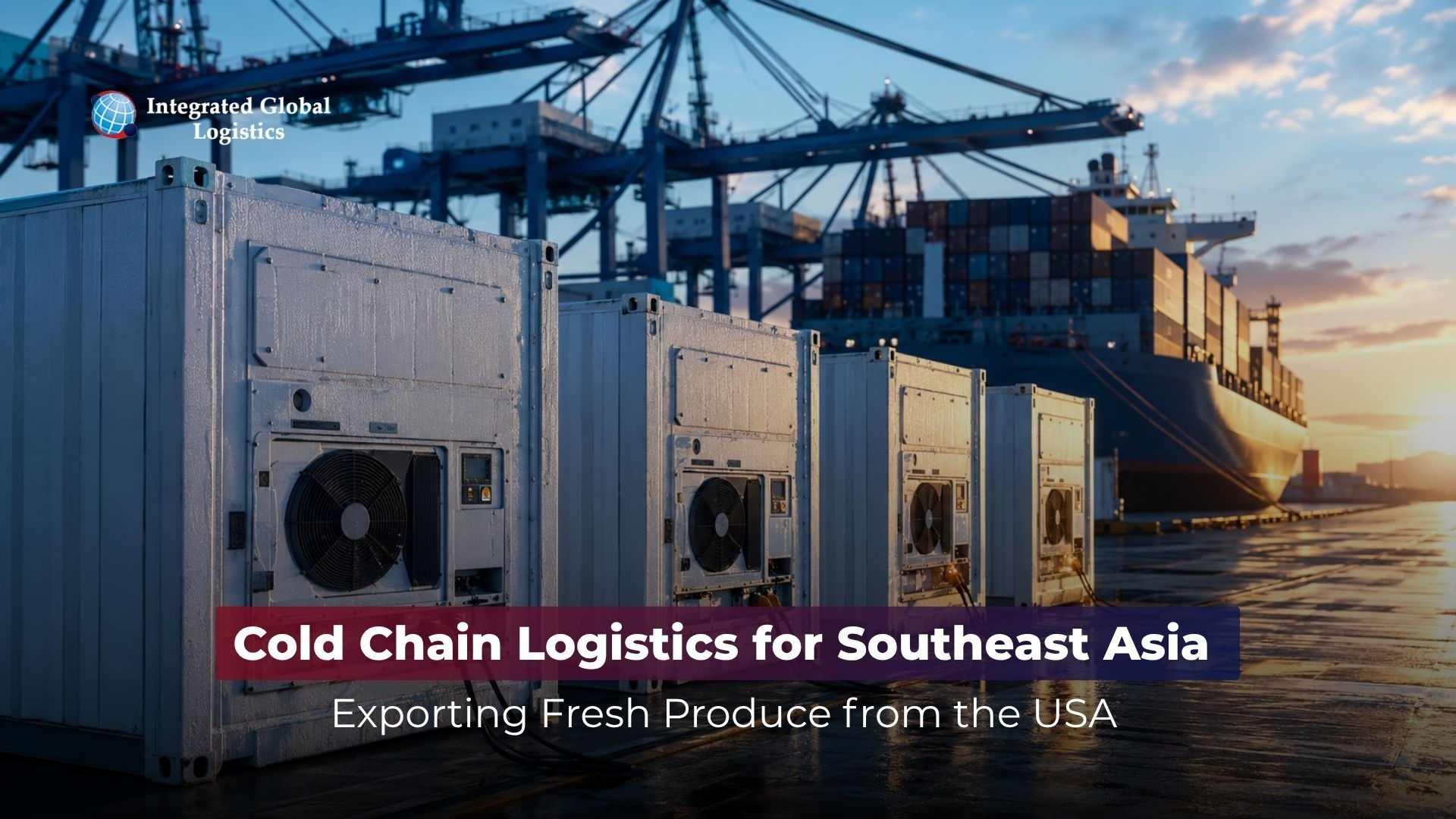
Cold chain logistics for Southeast Asia covers the temperature-controlled export of US fresh produce to markets such as Singapore, Vietnam, the Philippines, Thailand, Indonesia, and Malaysia. Produce exports require a USDA phytosanitary certificate and, for many fruits, cold treatment, along with an import permit and approved market access for the destination country. Ocean reefer transit from the US West Coast runs roughly 16 to 28 days depending on the destination, with air freight reserved for the most delicate, premium, or early-season fruit.
Southeast Asia has become one of the most important growth markets for US fresh produce. Rising incomes, expanding modern retail, and growing demand for safe, high-quality imported fruit have pulled steadily more American produce volume across the Pacific. For US exporters, the opportunity is real, but so is the difficulty: this is a long lane, a hot and humid destination region, and a patchwork of national rules that decide whether cargo is welcomed or rejected.
Produce cold chain shipping to the region rewards preparation and punishes guesswork. A shipment that arrives without the right phytosanitary paperwork can be refused at the border, and a container that loses temperature control across a multi-week voyage can arrive as a spoiled, unsellable load. This guide walks through what US produce exporters need to plan for, from certification and equipment to transit times and destination handling, so the fruit that leaves a US packhouse actually clears and sells in Southeast Asia.
Why Southeast Asia Is a Growing Market for US Produce
The region combines several trends that favor US produce exporters. A large and increasingly urban population is buying more fresh and imported fruit through supermarkets and online grocery. Imported US fruit carries a quality and food-safety reputation that supports premium positioning. And the logistics infrastructure that supports refrigerated trade, from port reefer plugs to cold storage, has improved across the major gateways.
US apples, table grapes, citrus, cherries, pears, stone fruit, and potatoes all move into the region in meaningful volume, with the exact mix shaped by season and by which commodities have market access into each country. At the same time, Southeast Asia is not a single market. Singapore functions as a sophisticated import and re-export hub with strong cold chain infrastructure. Vietnam and the Philippines are large, fast-growing consumer markets. Thailand, Indonesia, and Malaysia each present their own demand patterns and regulatory environments. Treating the region as one destination is the first mistake an exporter can make, because market access is granted country by country, commodity by commodity.
What a Produce Cold Chain Has to Protect
A produce cold chain is doing two jobs at once. It has to preserve the quality and shelf life of a living, respiring product, and it has to preserve the pest-free, compliant status that lets the product cross a border. A break in either chain can ruin a shipment, and the two are linked, because the same temperature control that keeps fruit fresh is often the same treatment that satisfies a phytosanitary requirement.
Quality and shelf life
Fresh produce continues to ripen and respire after harvest. Holding the correct temperature, and for some commodities the correct atmosphere, slows that process so the fruit arrives in saleable condition after weeks at sea. The cold chain starts at the packhouse with pre-cooling and continues unbroken through inland transport, the ocean leg, and destination handling.
Pest-free and compliant status
Every importing country wants assurance that incoming produce will not introduce pests. That assurance is delivered through inspection, certification, and, where required, a treatment such as cold treatment. If the documentation or the treatment record is incomplete, the cargo can be held or rejected regardless of how fresh it is.
Certifications and Compliance for Produce Exports
Fresh fruit and vegetable exports live or die on documentation and pest control. The destination country, not the exporter, sets the conditions for entry, and those conditions are specific to each commodity and origin. Getting them right before loading is the difference between a clean clearance and a rejected container.
The phytosanitary certificate
Most produce exports require a phytosanitary certificate issued by USDA APHIS, which attests that the shipment was inspected and found free of pests and diseases of concern to the importing country. US exporters obtain it through the Phytosanitary Certificate Issuance and Tracking System, working with an authorized certification official. The certificate is the foundation document, and many Southeast Asian markets will not release cargo without it.
Cold treatment and other phytosanitary treatments
For many fruits, a phytosanitary certificate alone is not enough. The destination may require a treatment that neutralizes fruit fly or other pest risk, and cold treatment is one of the most common. It holds the produce at a defined low temperature for a set number of days. A major advantage on a long ocean lane is that cold treatment can be applied in transit inside a reefer container that maintains the exact temperature and records it continuously, so the treatment and the voyage happen together rather than adding days at origin.
Import permits and market access
Beyond the certificate, most Southeast Asian countries require an import permit obtained by the buyer or importer, and the commodity must have approved market access for that specific country. A pathway that is open for one fruit from the USA into Vietnam may be closed for the same fruit into Indonesia. The exact requirements for each destination can be confirmed in the APHIS Phytosanitary Export Database before any cargo is committed, which is the single most reliable way to avoid a border surprise.
Food safety and labeling
Destination countries also apply their own food safety, residue, and labeling standards. Documentation needs to be complete and consistent across the commercial invoice, packing list, phytosanitary certificate, and any treatment records, because mismatches between documents are a frequent cause of delay at arrival.
Shipping Fresh Produce to Southeast Asia?
Integrated Global Logistics is a USMEF and USAPEEC certified, FMC licensed NVOCC that coordinates reefer FCL, in-transit cold treatment, documentation, and destination handling for US produce exporters. Tell us your commodity, destination, and set point and our team will respond within one business day.
Talk to a Cold Chain SpecialistReefer Equipment and Temperature Control
The container is the heart of an ocean cold chain. A refrigerated container, or reefer, is an insulated box with an integrated refrigeration unit that draws power from the vessel, the terminal, or a generator and holds a programmed set point. The choice of container and its settings is the foundation of the whole shipment, so matching cargo to the right reefer container specifications matters before anything leaves the packhouse.
Set point and airflow
Produce needs a precise and stable set point, not just cold air, and the correct temperature is commodity-specific. Many fresh fruits ship within a chilled band of roughly 0 to 4 degrees Celsius, while bananas need warmer conditions and frozen items ship near minus 18 degrees Celsius. A reefer maintains temperature by circulating air, so loading that preserves airflow around and through the cargo is essential, because blocked airflow leaves part of the load warmer than the set point.
Controlled atmosphere and pre-cooling
For some commodities, controlled atmosphere technology slows ripening by adjusting the oxygen and carbon dioxide inside the container, which extends shelf life across a long voyage and makes the difference between fruit that arrives firm and fruit that arrives spent. None of it works without proper pre-cooling at origin, because a reefer is built to hold a temperature, not to pull down a warm load quickly. Fruit should enter the container already at its target temperature.
Booking a full reefer container
Most produce exports move as full container load reefer shipments, because a dedicated container gives the exporter full control of the set point and avoids the handling that comes with shared space. Exporters new to the process benefit from understanding how to ship FCL before their first temperature-controlled booking, since the sequence of booking, equipment release, loading, and documentation is what keeps the cold chain unbroken from the start.
Transit Times from the USA to Southeast Asia
Transit time shapes both the equipment decision and the treatment plan. The figures below are typical port-to-port ocean estimates from the US West Coast in 2026. They exclude origin handling, export clearance, destination customs, and inland delivery, all of which extend the door-to-door timeline. Many Southeast Asia services also transship through a hub such as Singapore or Busan, which can add several days.
| US Origin | Southeast Asia Destination | Port-to-Port |
|---|---|---|
| Los Angeles / Long Beach | Singapore | 16 to 22 days |
| Los Angeles / Long Beach | Ho Chi Minh City, Vietnam | 18 to 24 days |
| Los Angeles / Long Beach | Manila, Philippines | 18 to 23 days |
| Los Angeles / Long Beach | Port Klang, Malaysia | 20 to 26 days |
| Los Angeles / Long Beach | Laem Chabang, Thailand | 21 to 28 days |
| Oakland | Jakarta, Indonesia | 22 to 28 days |
Exporters who already run FCL shipping across the Pacific will recognize the same carriers, ports, and seasonal patterns working in the export direction. The reefer voyage simply adds the requirement that the box stays powered and at set point for every day of that transit, including any time spent waiting for a transshipment connection.
Ocean or Air for Fresh Produce
Mode choice follows the commodity and its shelf life. Ocean reefer is the workhorse for most fresh produce, because it carries far more volume at a lower cost per unit and, with controlled atmosphere where needed, protects shelf life across a multi-week journey. Apples, grapes, citrus, pears, and potatoes generally travel well by sea when the cold chain is properly managed.
Air freight is reserved for the most delicate and time-sensitive items, such as berries and cherries, where a short shelf life and high value justify the cost and speed protects the product. Many exporters run both in parallel, moving steady volume by ocean to control cost and reserving air for premium or early-season fruit. The decision is rarely about price alone; it is about matching the transit time and temperature risk of the journey to the fragility and value of the cargo.
Destination Handling in Southeast Asia
The cold chain does not end when the vessel berths. The most vulnerable moments often come at destination, where the container must be plugged in promptly, cleared through customs and quarantine, and moved into a temperature-controlled facility without a gap in the chain.
Port reefer plugs and prompt connection
A reefer container holds temperature only while it has power. At a busy or warm-climate port, a delay in plugging the box into a reefer point can let temperature drift before clearance is complete. A capable destination agent ensures the container is connected promptly and monitored while it waits.
Customs, quarantine, and country rules
Each market runs its own customs and quarantine processes, and produce may face inspection and verification of phytosanitary documents on arrival. Because Singapore, Vietnam, the Philippines, Thailand, Indonesia, and Malaysia each apply distinct rules and approved commodity pathways, the destination agent needs genuine local competence with perishable cargo, not just a general clearing capability.
Cold store reception
The final step is the move into a cold store or distribution facility at the correct temperature. A verified, perishables-capable receiving facility protects the fruit through the last and most expensive stage of the journey, right up to the point it reaches the retailer or distributor.
Choosing a Cold Chain Partner for the Lane
A successful Southeast Asia produce program depends on a partner who can hold the whole chain together, because every handoff between separate providers is a place where temperature control or documentation can break. The right partner combines licensing, perishable certification, equipment control, in-house documentation, and a real destination network in the region.
This is where experienced international freight forwarding earns its place, coordinating the documentary chain, the reefer equipment, the inland legs at both ends, and the destination handling as a single managed process rather than a series of disconnected bookings. For temperature-sensitive cargo on a long lane, that coordination is the product.
Integrated Global Logistics is an FMC licensed NVOCC and international freight forwarder with USMEF certification, USAPEEC certification, and WCA Perishables membership. IGL's refrigerated cargo services coordinate reefer FCL booking, in-transit cold treatment, in-house documentation, temperature monitoring, inland transport, and destination cold store handling for US produce exporters shipping to Southeast Asia and 50+ countries worldwide.
Frequently Asked Questions
What certifications do US exporters need to ship fresh produce to Southeast Asia?
Fresh produce exports from the USA generally require a phytosanitary certificate issued by USDA APHIS through the Phytosanitary Certificate Issuance and Tracking System, which attests that the product is free of pests of concern. Many fruits also require a specific phytosanitary treatment such as cold treatment, plus an import permit from the destination country. Requirements vary by commodity and by country, and the destination market's exact rules can be checked in the APHIS Phytosanitary Export Database before shipping.
What is phytosanitary cold treatment and when is it required?
Phytosanitary cold treatment is a recognized nonchemical treatment that holds produce at a defined low temperature for a set number of days to neutralize fruit fly and other pest risk. It is required for many fresh fruits where the destination country mandates it for market access. Treatment can be completed before loading or applied in transit inside a reefer container that holds the precise temperature and records it, which lets the voyage and the treatment run at the same time.
What temperature should fresh produce ship at to Southeast Asia?
There is no single set point, because the correct temperature is commodity-specific. Many fresh fruits ship within a chilled band of roughly 0 to 4 degrees Celsius, while some items such as bananas need warmer conditions and frozen produce ships near minus 18 degrees Celsius. The reefer must hold the exact set point for that commodity without drift, and correct loading that preserves airflow around the cargo is essential to keep the whole load at temperature.
Should fresh produce to Southeast Asia move by ocean or air?
Ocean reefer is the standard choice for most fresh produce, because it carries far more volume at a lower cost per unit and, with controlled atmosphere where needed, protects shelf life across a multi-week voyage. Air freight suits only the most delicate, premium, or time-sensitive items such as berries and cherries, where speed protects a short shelf life. Many exporters move steady volume by ocean and reserve air for high-value early-season fruit.
What is controlled atmosphere shipping for produce?
Controlled atmosphere shipping adjusts the levels of oxygen and carbon dioxide inside a reefer container to slow the ripening and respiration of fresh produce. By holding the fruit in a modified atmosphere alongside the correct temperature, it extends shelf life across long voyages, which makes it valuable for commodities such as apples and pears moving from the USA to Southeast Asia. Not every commodity needs it, so the decision depends on the fruit and the length of the journey.
How long does ocean shipping from the USA to Southeast Asia take?
Port-to-port ocean reefer transit from the US West Coast to Southeast Asia typically runs about 16 to 28 days depending on the destination. Los Angeles or Long Beach to Singapore is around 16 to 22 days, to Ho Chi Minh City around 18 to 24 days, and to Jakarta or Laem Chabang closer to 22 to 28 days. Many services transship through a hub such as Singapore or Busan, which can add several days, and door-to-door timelines are longer once handling and clearance are included.
Which US ports are used for produce cold chain exports to Southeast Asia?
Most produce cold chain exports to Southeast Asia depart from US West Coast ports such as Los Angeles, Long Beach, Oakland, Seattle, and Tacoma, because they offer the shortest transpacific transit and frequent reefer services. Cargo from central and eastern growing regions reaches these gateways by refrigerated inland transport. Some shipments also route through Gulf and East Coast ports depending on origin, commodity, and the destination service available.
Do different Southeast Asian countries have different produce import rules?
Yes. Each Southeast Asian market sets its own import permits, phytosanitary conditions, and food safety requirements, so produce cleared for one country is not automatically eligible for another. Singapore, Vietnam, the Philippines, Thailand, Indonesia, and Malaysia each have distinct rules and approved commodity pathways. Confirming the exact requirements for the destination country before shipping is essential to avoid holds, rejection, or cargo loss.
IGL Freight Intelligence
IGL's Freight Intelligence content is produced by IGL's operations and ocean freight teams specializing in cold chain logistics, reefer FCL ocean freight, fresh produce exports, and inland trucking across 50+ countries. (732) 250-9000 | info@integratedgl.com